Kimberly Moon
The Moon, Earth's only natural satellite, has been a significant influence on human history, culture, and scientific exploration.
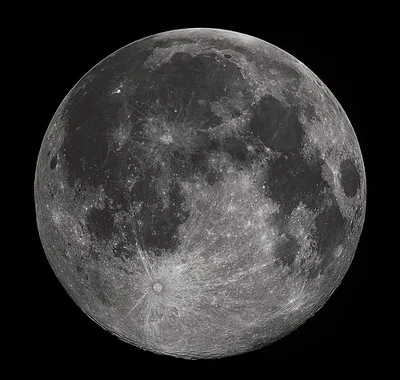
The Moon is Earth's sole natural satellite, orbiting at an average distance of approximately 384,399 kilometers. It is a geophysically significant celestial body, possessing a mass about 1.2% of Earth's and a diameter roughly one-quarter of our planet's. Its gravitational pull is the primary force behind Earth's tides, and it is tidally locked, always presenting the same face to Earth. The Moon's surface is characterized by impact craters and vast plains of cooled lava known as maria, formed by volcanic activity that ceased around 1.2 billion years ago. Its origin is theorized to be the result of a massive impact between the early Earth and a Mars-sized body, though precise details are still debated.
Historically, the Moon has profoundly impacted human civilization, serving as a crucial element in cosmography, mythology, religion, art, and timekeeping. It was the first extraterrestrial destination for human space exploration, beginning with Soviet probes and culminating in the Apollo missions, which landed twelve astronauts on its surface. Renewed interest in lunar exploration, driven by the potential discovery of water, is leading to new human missions. The Moon's presence has inspired countless cultural and scientific endeavors throughout history.
Symbolism and Cultural Significance
Across human history, the Moon has been a potent symbol and source of inspiration. Its cycles have been fundamental to early systems of timekeeping, influencing calendars and agricultural practices. In mythology and religion, the Moon has been personified as deities, such as the Greek Selene (also known as Artemis or Cynthia) and her Roman counterpart Diana, embodying aspects of the night, wilderness, and the hunt. Its phases, visible from Earth, have been interpreted in various spiritual and philosophical contexts, often associated with change, intuition, and the subconscious. The Moon's appearance in the night sky, as the brightest celestial object, has captivated observers and been a focal point for astronomical study and artistic expression for millennia, shaping our understanding of the cosmos and our place within it.
Scientific Exploration and Origin Theories
The Moon's scientific significance is underscored by its role as the first celestial body beyond Earth to be visited by humans. Early robotic missions from the Soviet Union and the United States paved the way for crewed landings, beginning with Apollo 11 in 1969. The study of lunar samples has provided crucial insights into planetary formation. While the exact origin of the Moon remains a subject of scientific inquiry, the prevailing theory suggests it formed approximately 4.51 billion years ago from debris ejected after a colossal impact between the proto-Earth and a Mars-sized protoplanet. This giant-impact hypothesis attempts to explain the Moon's mass, composition, and the angular momentum of the Earth-Moon system, though ongoing research continues to refine these models and address remaining discrepancies.
Astronomical Characteristics and Nomenclature
The Moon is Earth's only natural satellite, maintaining a consistent orbit at an average distance that is roughly 30 times Earth's diameter. Its gravitational interaction is the primary driver of Earth's ocean tides. Due to tidal locking, the Moon rotates at the same rate it orbits, meaning one side perpetually faces our planet. Astronomically, the Moon is a substantial celestial body, larger and more massive than any known dwarf planet. Its surface gravity is about one-sixth that of Earth. The English name 'Moon' has ancient roots, possibly related to measuring time, while the Latin term 'luna' gives rise to the adjective 'lunar'. In scientific contexts, 'Luna' is sometimes used to distinguish Earth's Moon from other moons in the solar system.
Key Ideas
- Tidal locking synchronizes the Moon's rotation with its orbit, causing it to always show the same face to Earth.
- The giant-impact hypothesis is the leading theory for the Moon's formation.
- The Moon's gravitational pull is the main cause of Earth's tides.
- The Moon was the first extraterrestrial destination for human space exploration.
Books by Kimberly Moon
8 free public domain books · Read online or download