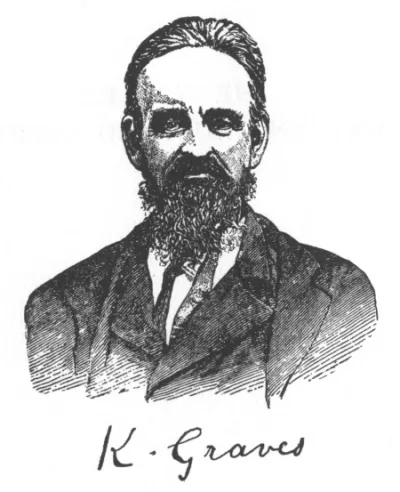
Kersey Graves
Kersey Graves was a 19th-century freethought writer, known for his skeptical views on religion and his book 'The World's Sixteen Crucified Saviors'.
Kersey Graves was a prominent writer on the American freethought circuit during the late 19th century. Born into a Quaker family, he initially followed their traditions, including a branch known as Hicksite Quakerism. His early life was marked by varied educational experiences, and he eventually became involved in social reform movements like Abolitionism and language reform. Graves's spiritual journey led him away from traditional Quakerism, influenced by radical freethinkers and philosophies emphasizing individual spiritual experience over established religious structures. He later became associated with groups exploring mesmerism and spiritualism. Graves married Lydia Michiner, and they had five children. He was disowned by his Quaker meeting for establishing a rival group and neglecting attendance. His philosophical leanings, shaped by Quakerism's "Inner Light" concept and Quietism, moved him towards a rejection of organized religion and eventually a belief that Jesus was a fictional construct.
Graves's writings became influential in skeptical circles, particularly his most famous work, "The World's Sixteen Crucified Saviors." This book, along with others like "The Biography of Satan" and "The Bible of Bibles," presented arguments questioning the historical uniqueness of Jesus and critiquing biblical narratives. Despite criticism from biblical scholars, his ideas have continued to be cited by proponents of the Christ myth theory and have been referenced by authors exploring comparative mythology and religious skepticism. Graves died in Indiana in 1883.
Early Life and Spiritual Evolution
Born in Pennsylvania in 1813, Kersey Graves's upbringing was within the Quaker tradition. He initially adhered to his parents' faith, later moving towards the Hicksite branch of Quakerism. Graves's formal education appears to have been limited, though accounts differ on the extent of his schooling. He pursued a career in teaching for over two decades. His involvement with radical freethinkers within Quakerism and his participation in utopian communities in Indiana marked a turning point. He was disowned by his Quaker meeting in 1844 due to his divergent practices and the establishment of a separate group, which later engaged with mesmerism and spiritualism. His marriage to Lydia Michiner in 1845 and their five children followed during this period of spiritual exploration.
Philosophical Influences and Religious Skepticism
Graves's Quaker background, particularly the emphasis on the "Inner Light" and the Hicksite focus on individual spiritual experience (Quietism), profoundly shaped his worldview. These philosophies led him to question the necessity of clergy, creeds, and formal worship. As he moved further from orthodox Quakerism, aligning with groups like the Congregational Friends, his skepticism deepened, leading him to question the foundations of Christianity and eventually to propose that Jesus was a mythical figure. This intellectual trajectory positioned him as a notable voice in 19th-century American freethought, challenging established religious doctrines and advocating for rationalist perspectives.
Writings and Legacy
Kersey Graves authored several influential works that articulated his skeptical views on religion. His most renowned book, "The World's Sixteen Crucified Saviors: Or, Christianity Before Christ" (1875), argued that the narrative of Jesus's life had parallels with earlier pagan myths. Other significant works include "The Biography of Satan; Or, A Historical Exposition of the Devil and His Fiery Dominions" (1865) and "The Bible of Bibles; Or, Twenty-Seven 'Divine Revelations'" (1879). Though often dismissed by mainstream biblical scholars, Graves's writings have been embraced by proponents of the Christ myth theory and have influenced later writers exploring comparative mythology and atheism, such as Dorothy M. Murdock and Tom Harpur. Madalyn Murray O'Hair was also an admirer of his work.
Key Ideas
- Skepticism towards organized religion and biblical narratives
- The Christ myth theory, suggesting Jesus's story is based on earlier pagan myths
- Critique of religious dogma and emphasis on rationalism
Notable Quotes
“I desire to impress upon the minds of my clerical brethren the important fact, that the gospel histories of Christ were written by men who had formerly been Jews (see Acts xxi. 20), and probably possessing the strong proclivity to imitate and borrow which their bible shows was characteristic of that nation ; and being written many years after Christ's death, according to that standard Christian author, Dr. Lardner, it was impossible, under such circumstances, for them to separate (if they had desired to) the real facts and events of his life from the innumerable fictions and fables then afloat everywhere relative to the heathen Gods who had pre-enacted a similar history. Two reasons are thus furnished for their constructing a history of Christ almost identical with that of other Gods.”
Books by Kersey Graves
4 free public domain books · Read online or download