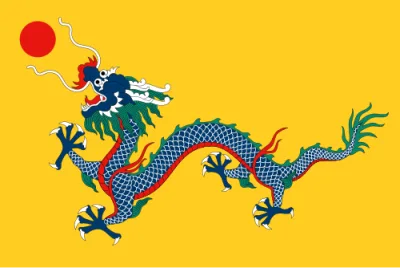
The Qing dynasty, founded by Manchus, ruled China from 1644 to 1912, shaping modern China's territorial base.
The Qing dynasty, officially the Great Qing, was an imperial dynasty of China established by the Manchu Aisin-Gioro clan. It officially ruled from 1644 to 1912, succeeding the Ming dynasty and being followed by the Republic of China. Originating from the Jurchen people, the dynasty unified various tribes under leaders like Nurhaci and Hong Taiji, who proclaimed the dynasty's name in 1636. The Qing eventually seized control of Beijing in 1644 and expanded its territory significantly, becoming the fourth-largest empire globally at its peak. The dynasty was multi-ethnic, incorporating Han Chinese, Mongols, and others, and defined China as a multi-ethnic state. Its rule saw periods of consolidation, cultural patronage, and expansion, but also faced internal revolts, economic challenges, and foreign interventions, leading to its eventual end with the Xinhai Revolution.
Formation and Early Rule
The Qing dynasty was established by the Manchus, a people descended from the Jurchens. Nurhaci, a Jurchen chieftain, unified tribes and founded the Later Jin dynasty in 1616, organizing the Eight Banners military system. His son, Hong Taiji, officially declared the Great Qing dynasty in 1636 and adopted the name "Manchu" for his people. After peasant rebels captured Beijing, the Qing army, led by Ming general Wu Sangui, seized the capital in 1644, marking the traditional start of their rule. The dynasty faced resistance from Ming remnants, with full conquest delayed until 1683. Early emperors like Kangxi consolidated control, patronized Confucianism and Buddhism, and encouraged scholarly pursuits and economic growth.
Imperial Expansion and Challenges
The Qing dynasty reached its zenith under the Qianlong Emperor, expanding its territory significantly and overseeing cultural projects. To maintain influence, they adapted the traditional tributary system, asserting dominance over neighboring states like Korea and Vietnam while controlling Inner Asia. However, after Qianlong's reign, the empire encountered internal issues such as revolts, corruption, and economic instability. Following defeats in the Opium Wars, foreign powers imposed unequal treaties, leading to a "century of humiliation." Major rebellions like the Taiping Rebellion caused immense loss of life. The dynasty attempted reforms, incorporating foreign military technology and later initiating broader administrative and fiscal changes, but faced setbacks including military defeats and internal conservative opposition.
Ideology and Identity
The Qing rulers promoted an ideology that defined China as a multi-ethnic state, encompassing territories beyond traditional Han areas. They used "China" and "Qing" interchangeably in official documents and equated the lands under their rule, including present-day Northeast China, Xinjiang, Mongolia, and Tibet, as integral parts of "China." The concept of "one family" (Zhōngwài yījiā or nèiwài yījiā) was employed to foster unity among diverse populations, including Han, Manchu, and Mongol subjects. The name "Qing" itself possibly contrasted with "Ming" through elemental associations (water vs. fire) and may have held Buddhist connotations of enlightenment.
Key Ideas
- Multi-ethnic definition of China
- Qing ideology of trans-cultural unity (Zhōngwài yījiā)
- Eight Banners military system
- Adaptation of the tributary system
Books by
1 free public domain book · Read online or download