Julian of Norwich, Julia Bolton Holloway
Julian of Norwich was a medieval English mystic and anchoress whose visions of Christ's Passion form the earliest known English-language work by a woman.
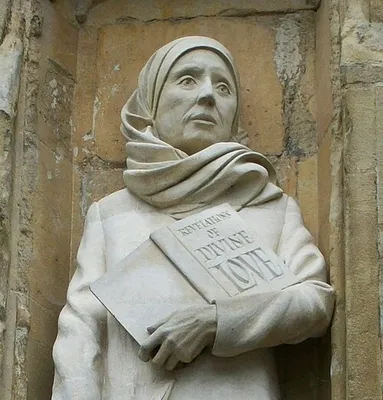
Julian of Norwich, also known as Mother Julian or Dame Julian, was a medieval English Catholic anchoress who lived in Norwich. She is recognized as the author of Revelations of Divine Love, the earliest surviving English-language writings attributed to a woman and the only such works by an anchoress. Despite living through turbulent times in Norwich, including the Black Death and the Peasants' Revolt, Julian received a series of divine visions in 1373, which she later documented. Her life was dedicated to seclusion as an anchoress attached to St. Julian's Church, Norwich.
Little is definitively known about Julian's personal life before she became an anchoress, including her given name. Her writings, initially composed as a shorter account of her visions and later expanded into a longer theological exploration, were preserved but not widely published until centuries after her death. She was recognized as a spiritual authority during her lifetime, notably advising the mystic Margery Kempe. Julian is now regarded as a significant figure in Christian mysticism and theology.
Mystical Experiences and Writings
Julian experienced a profound series of 15 visions of Christ's Passion in 1373, an event she believed occurred when she was gravely ill and near death. She recovered and subsequently wrote about these "shewings." Initially, she produced a shorter manuscript, known as the Short Text, shortly after her recovery. Many years later, she embarked on a more extensive theological examination of these visions, resulting in the Long Text. This later work, which underwent revisions over time, delves deeply into the spiritual meaning of her experiences. While her gender and personal details were less emphasized in the Long Text compared to the Short Text, her writings are considered the earliest surviving English-language works by a woman and the only ones by an anchoress.
Life as an Anchoress in Medieval Norwich
Julian lived as an anchoress, a type of religious hermit enclosed in a small cell, typically attached to a church. Her cell was situated at St. Julian's Church in Norwich, a significant commercial and religious center. During her lifetime, Norwich endured severe hardships, including the Black Death, the Peasants' Revolt, and the suppression of the Lollards. Despite these societal upheavals, Julian's writings do not directly reference these events, suggesting a focus on her internal spiritual life. She was known within her community as a spiritual advisor, with evidence of this role coming from wills that bequeathed sums to her and the account of Margery Kempe's visit seeking counsel.
Historical Context and Legacy
Norwich, where Julian likely spent her entire life, was a prominent city in medieval England. Its religious landscape was rich, featuring numerous churches, monasteries, and hermit cells. Julian's seclusion as an anchoress placed her within this vibrant religious milieu. While her writings were carefully preserved, the Reformation delayed their widespread publication. The Long Text was first printed in the 17th century, but Julian's work only gained significant modern recognition in the early 20th century. Today, she is acknowledged as an influential Christian mystic and theologian, with her Revelations of Divine Love considered a foundational text in English mystical literature.
Key Ideas
- Divine revelations and visions of Christ's Passion
- Theological exploration of divine love
- The maternal nature of God
- Spiritual counsel and authority within a community
Books by Julian of Norwich, Julia Bolton Holloway
2 free public domain books · Read online or download