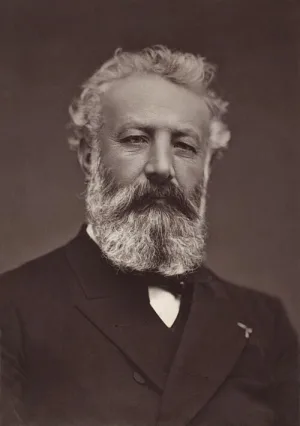
Jules Verne was a prolific French writer known for adventure novels blending contemporary science with imaginative storytelling.
Jules Verne, a French novelist, poet, and playwright born in 1828, is renowned for his "Voyages extraordinaires" series. Collaborating with publisher Pierre-Jules Hetzel, he penned bestselling adventure novels such as "Journey to the Center of the Earth," "Twenty Thousand Leagues Under the Seas," and "Around the World in Eighty Days." These works typically explored themes of scientific knowledge and technological advancements of the latter half of the 19th century.
Beyond his famous novels, Verne also produced plays, short stories, poetry, and various studies. His literary output has been extensively adapted for film, television, and other media since the dawn of cinema. While highly regarded in Europe for his influence on literary movements like surrealism, his reputation in the Anglosphere was historically diminished by abridged and altered translations, often categorizing him as a genre or children's author. However, his literary standing has improved significantly since the 1980s, and he is recognized as one of the most translated authors globally.
Early Life and Influences
Born in Nantes, France, Jules Verne's early life was shaped by the river Loire and his family's maritime connections. His father, a lawyer, initially intended for Verne to follow in his legal footsteps. However, Verne displayed an early aptitude for writing and a fascination with geography and recitation. Childhood experiences, including attending boarding school and visiting an uncle who was a retired shipowner, instilled in him a love for adventure and travel. A pivotal, though possibly embellished, childhood incident involved an attempt to join a ship bound for the Indies, which his father intercepted, reportedly telling him to travel only in his imagination. This early exposure to seafaring and tales of distant lands likely fueled his later imaginative works.
Literary Beginnings and Parisian Sojourn
By his late teens, Verne was actively writing, producing plays and prose works, though his father's desire for him to pursue law led him to Paris. While studying law, Verne immersed himself in the Parisian literary scene, frequenting salons and developing friendships with artists and musicians, notably composer Aristide Hignard. He was deeply influenced by Victor Hugo's works, particularly his dramatic writing. Despite continuing his legal studies, Verne's passion lay in theater and literature. This period in Paris, marked by the political turbulence of the 1848 revolution, also exposed him to contemporary societal changes, which would later inform his narratives.
Themes and Literary Legacy
Verne's novels are characterized by their meticulous attention to contemporary scientific understanding and technological progress, woven into compelling adventure narratives. His work often explores themes of exploration, discovery, and humanity's relationship with nature and innovation. The recurring motif of young women married against their will, possibly stemming from a personal unrequited love affair in his youth, has been noted by scholars. His extensive body of work, including novels, plays, and short stories, has secured his place as a globally significant author, influencing subsequent generations of writers and captivating audiences across various media for over a century.
Key Ideas
- Adventure novels blending scientific knowledge and technological advances of the 19th century.
- Exploration of contemporary scientific understanding and technological progress.
- Themes of exploration, discovery, and humanity's relationship with nature and innovation.
- Recurring motif of young women married against their will.
Books by
3 free public domain books · Read online or download