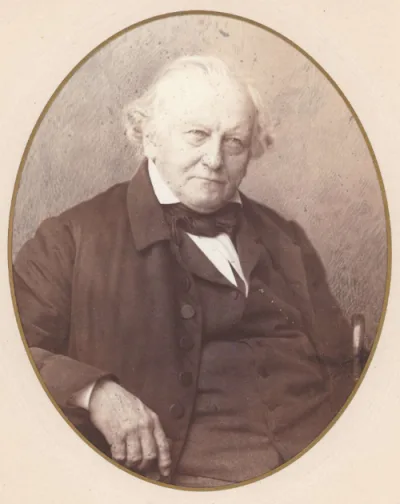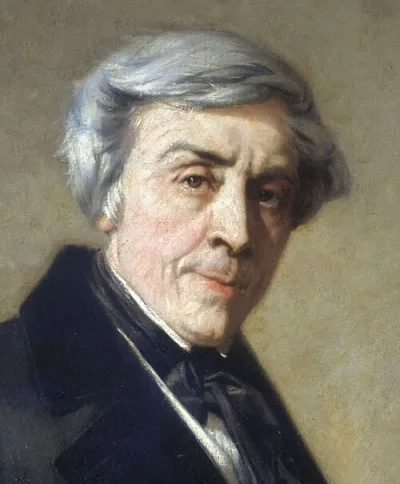
Jules Michelet
Jules Michelet was a French historian who defined the Renaissance and explored cyclical history, humanism, and nature.
Jules Michelet (1798–1874) was a prominent French historian and writer, best known for his extensive "Histoire de France." Influenced by Giambattista Vico, Michelet emphasized the role of ordinary people and societal customs in history, moving away from elite-centric narratives. He also adopted Vico's idea of history as cyclical, with societies repeating patterns of rise and fall.
Michelet is credited with popularizing the term "Renaissance" to describe the European cultural shift from the Middle Ages, framing it as a period of renewed humanism and intellectual growth. His work on the French Revolution is considered foundational. Beyond grand historical narratives, Michelet also delved into themes of nature, human relationships, and less conventional subjects like witchcraft, reflecting a complex worldview that blended romanticism, republicanism, and pantheism. His personal life included two marriages, and he lost a significant position due to his refusal to pledge loyalty to the emperor.
Historical Philosophy and the Renaissance
Jules Michelet's approach to history was significantly shaped by Giambattista Vico, particularly Vico's focus on the collective actions and customs of common people as drivers of historical change, a departure from traditional accounts centered on rulers and military leaders. Michelet embraced Vico's concept of "corsi e ricorsi," the idea that history unfolds in recurring cycles of societal ascent and decline. In his monumental "Histoire de France," Michelet coined and systematically applied the term "Renaissance" (meaning "rebirth") to characterize the European era that marked a distinct break from the Middle Ages. His interpretation established the modern view of this period as a time of burgeoning humanism, artistic achievement, and intellectual transformation.
Later Works and Esoteric Interests
Following political shifts in France, Michelet lost his position at the Record Office but continued his prolific writing. His later works explored diverse themes, including natural history with titles like "L'Oiseau" (1856) and "La Mer" (1861), reflecting a pantheistic perspective influenced by his second wife, Athénaïs. These nature studies often employed a lyrical and emotionally charged style. Michelet also ventured into more unconventional territory with "L'Amour" (1859), "La Femme" (1860), and notably "La Sorcière" (Satanism and Witchcraft) in 1862. "La Sorcière" explored historical and mystical aspects of witchcraft, drawing on his more unconventional views and later inspiring an animated film. Despite his continued output, these later works received less critical acclaim than his earlier historical writings.
Themes and Dualisms
Michelet's historical and philosophical writings were characterized by several recurring themes, often presented in dualistic or paired concepts. He explored concepts he categorized as "maleficent" and "beneficent," alongside "paired" themes. For instance, he discussed grace (associated with the feminine) and justice (associated with the masculine). A prominent theme was martial dualism, encapsulated in his view that "History is nothing other than the record of this interminable struggle" between opposing forces like man against nature, spirit against matter, and liberty against fatality. His "maleficent" themes included abstract concepts like "the dry" (associated with machines, Jesuits, fatalism) and "the empty and the turgid" (linked to the Middle Ages, imitation, tedium), alongside "the indeterminate."
Key Ideas
- Emphasis on the role of ordinary people and customs in history
- Cyclical nature of history (corsi e ricorsi)
- Definition and popularization of the term "Renaissance" as a distinct historical era
- Pantheistic worldview influencing nature studies
- Exploration of dualistic themes (e.g., grace/justice, spirit/matter, liberty/fatality)
Books by Jules Michelet
6 free public domain books · Read online or download