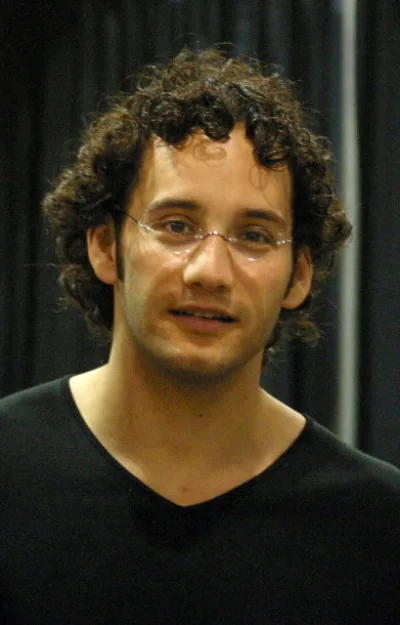
Josh Waitzkin is a former chess prodigy, martial arts champion, and author known for his insights into learning and performance.
Joshua Waitzkin, born in 1976, achieved recognition at a young age for his exceptional talent in chess, winning national championships and being the subject of the film "Searching for Bobby Fischer." His early chess journey began in New York City's Washington Square Park and involved formal study with Bruce Pandolfini. Waitzkin excelled academically as well, leading his school to numerous team championships. He achieved the titles of National Master at 13 and International Master at 16. He later studied philosophy at Columbia University. Waitzkin has largely retired from competitive chess, citing a growing distance from the game and a desire for deeper exploration beyond the pressure to constantly win.
Beyond chess, Waitzkin has achieved significant success in martial arts, becoming a world champion in tai chi pushing hands and earning a black belt in Brazilian jiu-jitsu. He has also coached martial arts teams to international victories. Waitzkin has authored books, including "The Art of Learning," which explores the learning process and performance psychology through his diverse experiences. He has also served as a spokesperson for the Chessmaster video game series and has been consulted by professional sports organizations.
Chess Prodigy and Transition
Joshua Waitzkin's early life was marked by a profound connection to chess, discovered at age six in Washington Square Park. Under the tutelage of Bruce Pandolfini, he rapidly ascended in the chess world. His prodigious talent led him to win multiple U.S. Junior Chess championships in 1993 and 1994, and his early life was famously chronicled in the book and film "Searching for Bobby Fischer." Waitzkin achieved the title of National Master at thirteen and International Master at sixteen. Despite his success, he eventually stepped away from competitive chess, explaining that he felt a separation from his passion, driven by an intense need to win rather than a freedom to explore the game's artistic depths. His last formal tournaments were before the year 2000.
Martial Arts Mastery and Coaching
Transitioning from chess, Waitzkin found a new arena for his competitive spirit and dedication in martial arts. He achieved world champion status in tai chi pushing hands in 2004 and has earned multiple national medals in the discipline. Waitzkin also demonstrated strong leadership as a coach, guiding the U.S. Pushing Hands Team to several Tai Chi World Cup titles. His martial arts journey extends to Brazilian jiu-jitsu, where he holds a black belt under Marcelo Garcia. He has co-founded institutions dedicated to martial arts training and instruction, including MGInAction.com and The Marcelo Garcia Academy in New York City.
The Art of Learning and Performance
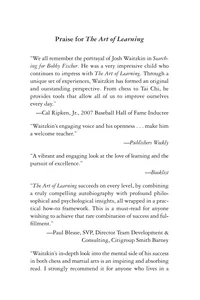
Waitzkin's experiences across diverse disciplines have informed his philosophical approach to learning and peak performance, which he has articulated in his writing. His book, "The Art of Learning: An Inner Journey to Optimal Performance," draws parallels between the mental and strategic demands of chess and martial arts, offering insights into the learning process, skill acquisition, and the psychology of optimal execution. This work reflects a deeper exploration of how mastery is achieved and maintained, moving beyond mere technical proficiency to encompass the internal journey of the learner. He has also contributed advice to other authors discussing success strategies.
Key Ideas
- The learning process involves an inner journey towards optimal performance.
- Mastery in any field requires understanding the psychological and strategic demands.
- The pursuit of winning can sometimes alienate individuals from the art they love.
Notable Quotes
“When people ask me why I stopped playing chess ... I tend to say that I lost the love. And I guess if I were to be a little bit more true, I would say that I became separated from my love; I became alienated from chess somewhat ... The need that I felt to win, to win, to win all the time, as opposed to the freedom to explore the art more and more deeply, and I think that started to move me away from the game and also chess for me was so intimate. It was something that I loved so deeply that when I started to become alienated from it, I couldn't do it in an impure way.”
Books by
2 free public domain books · Read online or download