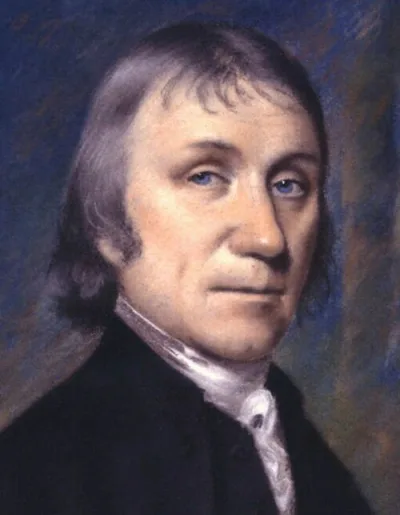
Joseph Priestley
Joseph Priestley was a chemist, theologian, and educator who discovered oxygen and invented carbonated water, blending science with his religious and political views.
Joseph Priestley (1733–1804) was a multifaceted English figure, known as a chemist, theologian, educator, and political theorist. He made significant scientific contributions, including the independent discovery of oxygen in 1774 and the invention of carbonated water. Priestley also developed several "airs," notably "dephlogisticated air," which is now known as oxygen. Despite his scientific achievements, he remained a staunch defender of the phlogiston theory, which eventually led to his isolation within the scientific community as chemical understanding evolved.
Priestley's scientific pursuits were deeply intertwined with his theological and philosophical beliefs. He sought to reconcile Enlightenment rationalism with Christian theism, attempting to unite concepts of theism, materialism, and determinism in his metaphysical writings. He believed that understanding the natural world would lead to human progress and the fulfillment of the Christian millennium. A strong advocate for the free exchange of ideas and religious toleration, Priestley was instrumental in the founding of Unitarianism in England. His outspoken support for the American and French Revolutions, coupled with his controversial publications, led to public and governmental opposition, forcing him to emigrate to the United States after his home and church were destroyed by a mob.
Scientific Discoveries and Chemical Theories
Priestley is prominently recognized for his independent discovery of oxygen in 1774, isolating it through the thermal decomposition of mercuric oxide. He also invented carbonated water by developing a method to infuse water with carbon dioxide. During his career, Priestley identified several "airs" (gases), the most famous being "dephlogisticated air," later understood to be oxygen. His scientific reputation was also built upon his work with electricity. However, Priestley's commitment to defending the phlogiston theory, a concept that was eventually superseded, led to his scientific isolation as the chemical revolution progressed.
Theology, Philosophy, and Political Thought
Priestley's scientific work was inseparable from his theological and philosophical views. He endeavored to synthesize Enlightenment rationalism with Christian theism, exploring audacious and original metaphysical ideas that combined theism, materialism, and determinism. He posited that a thorough comprehension of the natural world would facilitate human advancement and usher in the Christian millennium. A fervent believer in the unrestricted exchange of ideas, Priestley championed religious toleration and equal rights for Dissenters, playing a key role in the establishment of Unitarianism in England. His strong advocacy for the American and French Revolutions, alongside his polemical writings, generated significant public and governmental animosity, ultimately compelling him to flee to the United States.
Educational Contributions and Lasting Influence
Throughout his life, Priestley was dedicated to scholarship and teaching, making significant contributions to pedagogy. He authored influential works on English grammar, history, and education, including early and important timelines. His educational writings were widely popular, emphasizing the practical needs of students and advocating for the study of modern languages and history. Beyond his pedagogical work, Priestley's metaphysical writings are considered to have had a profound and lasting impact, serving as primary sources for utilitarian philosophers such as Jeremy Bentham, John Stuart Mill, and Herbert Spencer. His "Essay on the First Principles of Government" is regarded as an early foundational text in modern liberal political theory.
Key Ideas
- Discovery of oxygen
- Invention of carbonated water
- Defense of phlogiston theory
- Fusion of rationalism and Christian theism
- Advocacy for religious toleration and equal rights
- Belief in human progress through understanding nature
- Contributions to pedagogy and liberal political theory
Notable Quotes
“This proved a very suitable and happy connexion, my wife being a woman of an excellent understanding, much improved by reading, of great fortitude and strength of mind, and of a temper in the highest degree affectionate and generous; feeling strongly for others, and little for herself. Also, greatly excelling in every thing relating to household affairs, she entirely relieved me of all concern of that kind, which allowed me to give all my time to the prosecution of my studies, and the other duties of my station.”
Books by Joseph Priestley
7 free public domain books · Read online or download