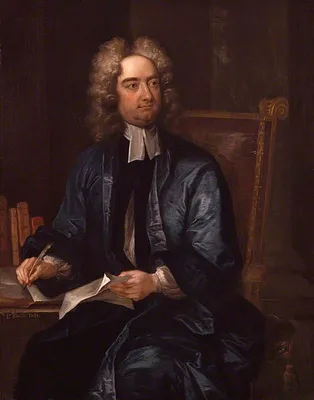
Jonathan Swift
Jonathan Swift was a celebrated Anglo-Irish satirist, essayist, and cleric known for Gulliver's Travels and a distinctive ironic writing style.
Jonathan Swift (1667-1745) was a prominent Anglo-Irish writer, essayist, satirist, and Anglican cleric. He is widely recognized as one of the greatest satirists of his era and a significant figure in English and world literature. Swift authored notable works such as 'Gulliver's Travels' (1726), 'A Tale of a Tub' (1704), and 'An Argument Against Abolishing Christianity' (1708). He often published under pseudonyms, including Lemuel Gulliver and Isaac Bickerstaff, and mastered both Horatian and Juvenalian styles of satire. His unique deadpan and ironic writing, exemplified in 'A Modest Proposal' (1729), led to the term "Swiftian" satire. Swift's early career involved extensive travel in Ireland and Great Britain, which informed his keen observations of human nature and society. He served as the dean of St. Patrick's Cathedral in Dublin from 1713, earning him the moniker "Dean Swift."
His writings frequently drew upon his political experiences and observations of the British government. Swift's intellectual connections included prominent figures of his time, and his family had literary ties, including a relationship to poet John Dryden. Despite facing political sensitivities, he utilized pseudonyms to protect himself. Globally, Swift remains a highly regarded Irish author, with 'Gulliver's Travels' being one of the most widely printed books by an Irish writer. His enduring legacy is evident in numerous dedications and his influence on subsequent authors like George Orwell.
Early Life and Education
Born in Dublin in 1667, Jonathan Swift's early life was marked by his father's death before his birth and his mother's return to England, leaving him in the care of his uncle Godwin Swift. He spent time in Whitehaven, England, where he learned to read, before returning to Ireland. Swift's family had notable literary connections, including kinship with poet John Dryden and author Francis Godwin, whose work may have influenced 'Gulliver's Travels.' He attended Kilkenny College and later Trinity College Dublin, where he pursued a curriculum focused on Aristotelian logic and debate, graduating with a B.A. in 1686.
Literary Career and Satirical Style
Swift's literary career flourished through his mastery of satire, employing both Horatian and Juvenalian styles. He is renowned for 'Gulliver's Travels' (1726), which introduced the fictional land of Lilliput. Other significant works include 'A Tale of a Tub' (1704) and 'An Argument Against Abolishing Christianity' (1708). Swift consistently published under pseudonyms like Lemuel Gulliver and Isaac Bickerstaff, a practice scholars suggest offered protection in the politically charged atmosphere of England and Ireland. His signature deadpan and ironic tone, particularly evident in 'A Modest Proposal' (1729), gave rise to the term "Swiftian" satire, reflecting its profound influence.
Clerical Service and Political Engagement
Swift's adult life involved significant clerical service, culminating in his appointment as dean of St. Patrick's Cathedral in Dublin in 1713, earning him the nickname "Dean Swift." His early career included extensive travel across Ireland and Great Britain, providing him with deep insights into societal conditions and human behavior, which he skillfully wove into his satirical writings. He was affiliated with the Whig party and supported the Glorious Revolution. His writings often reflected his political experiences, particularly his interactions with the British government during the Tory administration. His time ministering to a small congregation at Laracor allowed him considerable leisure for personal pursuits and writing.
Key Ideas
- Swiftian satire: a term for his distinctive deadpan and ironic writing style.
- Horatian and Juvenalian satire: mastery of both classical satirical modes.
- Pseudonymous publication: used to avoid persecution in politically sensitive times.
Books by Jonathan Swift
2 free public domain books · Read online or download