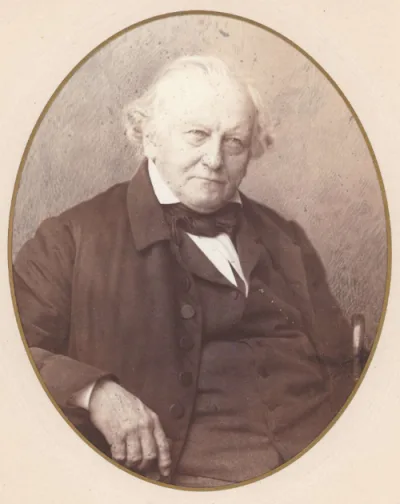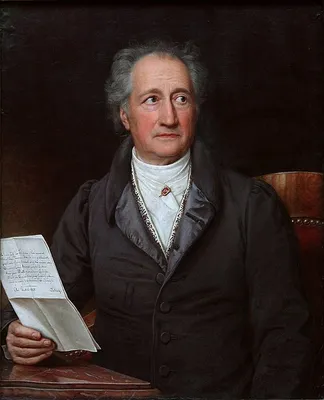
Johann Wolfgang von Goethe
Johann Wolfgang von Goethe was a German polymath whose influential writings and scientific inquiries shaped Western thought and literature.
Johann Wolfgang von Goethe (1749–1832) was a towering figure in German literature and a polymath whose influence extended across literary, political, Christian, and philosophical domains in the Western world. His career spanned poetry, drama, novels, science, and statesmanship. Settling in Weimar in 1775, he became a central figure in Weimar Classicism, a significant intellectual and cultural movement. Goethe's early involvement in the Sturm und Drang movement and his administrative roles in Weimar demonstrate a multifaceted engagement with society and governance. Goethe's literary output includes seminal works like "The Sorrows of Young Werther" and the first part of "Faust." His scientific pursuits, particularly his work on botany and color theory, were also notable. His intellectual circle included prominent thinkers like Friedrich Schiller, Johann Gottlieb Fichte, and Alexander von Humboldt, whose collaborations defined the Weimar Classicism era. His legacy is cemented by praise from philosophers like Arthur Schopenhauer and Ralph Waldo Emerson.
Early Life and Influences
Born into a prominent Frankfurt family, Johann Wolfgang von Goethe received a comprehensive education in languages, arts, and practical skills. His early fascination with drawing, literature, history, and religion, coupled with experiences like observing puppet shows and early literary attempts involving figures who would later appear in "Faust," laid the groundwork for his creative output. He studied law, though his true passion lay in literature and observation, leading him to explore various philosophical and poetic influences, including classical authors and contemporary thinkers.
Literary and Scientific Pursuits
Goethe's literary career began with early collections of poems and plays, but he gained international acclaim with the epistolary novel "The Sorrows of Young Werther" (1774). His scientific interests manifested in works such as "Metamorphosis of Plants," published after his Italian journey. He managed Weimar's theatre and maintained a significant intellectual partnership with Friedrich Schiller, premiering Schiller's plays. This period saw the creation of "Wilhelm Meister's Apprenticeship" and the first part of his magnum opus, "Faust."
Weimar Classicism and Intellectual Impact
Goethe became a central figure in Weimar Classicism, an intellectual and cultural movement that flourished under the patronage of the Duchess Anna Amalia. His interactions and collaborations with figures like Schiller, Fichte, Herder, and the Humboldt brothers were crucial to this era. His ennoblement in 1782 further solidified his status. Goethe's extensive administrative duties in Weimar, including overseeing mining operations and university reforms, highlight his deep involvement in public life alongside his creative and scholarly endeavors.
Key Ideas
- Exploration of human emotion and societal pressures in "The Sorrows of Young Werther".
- Scientific inquiry into natural transformation, particularly in botany.
- The concept of "Weimar Classicism" as a synthesis of Enlightenment ideals and Romantic sensibility.
- The dramatic exploration of human ambition, knowledge, and spiritual struggle in "Faust".
Notable Quotes
“I had from childhood the singular habit of always learning by heart the beginnings of books, and the divisions of a work, first of the five books of Moses, and then of the Aeneid and Ovid's Metamorphoses [...] If an ever active imagination, of which that tale may bear witness, led me hither and thither, if the medley of fable and history, mythology and religion, threatened to bewilder me, I readily fled to those oriental regions, and plunged into the first books of Moses, and there, amid the scattered shepherd tribes, found myself at once in the greatest solitude and the greatest society.”
Books by Johann Wolfgang von Goethe
2 free public domain books · Read online or download