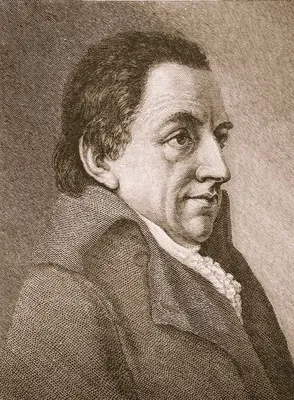
Johann Gottlieb Fichte
Johann Gottlieb Fichte was a German idealist philosopher known for his ideas on self-consciousness and his role in German nationalism.
Johann Gottlieb Fichte (1762–1814) was a pivotal German philosopher and a key figure in the development of German idealism, building upon Immanuel Kant's work. His philosophical contributions centered on the nature of self-consciousness and he is also credited with originating the concept of thesis-antithesis-synthesis, often mistakenly attributed to Hegel. Fichte grappled with the problems of subjectivity and consciousness, similar to Descartes and Kant. Beyond his abstract philosophical inquiries, Fichte also engaged with political philosophy and is recognized as a foundational figure in German nationalism.
Born in Upper Lusatia to a pious family, Fichte's early education was supported by a local landowner due to his remarkable memory. He received classical training and later studied theology at Jena and Leipzig, though financial difficulties prevented him from completing his degree. After working as a tutor, he encountered Kant's philosophy in 1790, which profoundly influenced his thought. His early major work, "Attempt at a Critique of All Revelation," initially published anonymously, was so impressive that it was mistaken for Kant's own, leading to a surge in Fichte's reputation when the truth emerged. Despite initial acclaim, Fichte later faced controversy and was dismissed from the University of Jena in 1799 due to accusations of atheism following his essay on divine world-governance. He continued his academic and literary career in Berlin and later Erlangen, delivering influential lectures and writings, including the "Addresses to the German Nation."
Philosophical Foundations and Self-Consciousness
Fichte emerged as a foundational figure in German idealism, significantly extending the philosophical inquiries initiated by Immanuel Kant. His work is particularly noted for its original contributions to understanding self-consciousness or self-awareness, making him a philosopher of considerable importance in his own right. Like earlier thinkers such as Descartes and Kant, Fichte was deeply concerned with the philosophical problem of subjectivity and the nature of consciousness. He is also recognized as the originator of the dialectical method of thesis-antithesis-synthesis, a concept frequently, though incorrectly, associated with Georg Wilhelm Friedrich Hegel. Fichte's philosophical system sought to establish a rigorous account of the self's activity in constituting its experience and the world.
Early Life and Influences
Born in Rammenau, Upper Lusatia, Johann Gottlieb Fichte was baptized a Lutheran and came from a devout family with a long history in the region. His father, a ribbon weaver, married above his social standing, and some have suggested Fichte inherited his characteristic impatience from his mother. His early education was basic but he displayed exceptional abilities from a young age. A local landowner, Freiherr von Miltitz, recognized Fichte's talent after hearing him recount a sermon verbatim and took him under his patronage, funding his further education. This led to Fichte receiving a thorough classical education at Pastor Krebel's household and later at the prestigious Pforta school, an institution also attended by figures like Novalis and Nietzsche.
Academic Struggles and Kantian Engagement
Fichte began theological studies at the University of Jena in 1780, transferring to Leipzig the following year. He faced significant poverty and struggle, as financial support from von Miltitz, who died in 1774, ceased, preventing him from completing his degree. He worked as a tutor for various families from 1784 to 1788. In Zurich, where he lived from 1788 to 1790, he met his future wife, Johanna Rahn, and Johann Heinrich Pestalozzi, and became a Freemason. It was in the summer of 1790, prompted by a student's inquiry, that Fichte began to study the works of Immanuel Kant, an engagement that would profoundly shape his philosophical trajectory. Financial difficulties of the Rahn family led to a postponement of his marriage.
The 'Critique of All Revelation' and Public Acclaim
After a brief, unsatisfactory tutorship in Warsaw, Fichte secured an opportunity to meet Immanuel Kant in Königsberg. Following a disappointing interview, Fichte dedicated himself to writing an essay intended to capture Kant's attention. This work, "Attempt at a Critique of All Revelation" (1792), explored the connections between divine revelation and Kant's critical philosophy. Published anonymously and without Fichte's name, the work was so masterful that it was widely assumed to be a new publication by Kant himself. This mistaken attribution led to Fichte's reputation soaring when Kant clarified the authorship and praised the work. However, Kant later distanced himself from Fichte after external pressures, famously remarking, "May God protect us from our friends."
Jena, Political Philosophy, and the Atheism Dispute
In 1793, Fichte married in Zurich and became involved with the ideals of the French Revolution, anonymously publishing pamphlets advocating for liberty and political reform. This led to an invitation to become an extraordinary professor of philosophy at the University of Jena in 1794, where he lectured on his system of "transcendental idealism." His lectures were successful, characterized by his earnest and forceful personality, and later published as "The Vocation of the Scholar." In 1799, Fichte was dismissed from Jena due to an "atheism dispute" stemming from his essay "On the Ground of Our Belief in a Divine World-Governance," where he defined God as the "living and efficaciously acting moral order." His public defense of his views led to further controversy, including an open letter from F. H. Jacobi equating his philosophy with nihilism.
Later Years in Berlin and Nationalism
Forced to relocate due to the controversy, Fichte moved to Berlin, associating with prominent intellectuals like the Schlegel brothers and Schleiermacher. He was initiated into Freemasonry and became involved in philosophical discussions about its higher degrees, publishing "Philosophy of Freemasonry: Letters to Konstant." In 1800, he published "The Closed Commercial State," a philosophical sketch on property theory and economic reform. After a professorship at Erlangen and a period displaced by the Napoleonic Wars, Fichte returned to Berlin. In 1807-1808, he delivered his influential "Addresses to the German Nation," which sought to define German identity and inspire resistance against Napoleon. He became a professor and later rector at the new University of Berlin, though his temperament led to his resignation in 1812. Fichte died of typhus in 1814, having contracted it while caring for his wife, who was ill with fever contracted while nursing soldiers.
Key Ideas
- German Idealism
- Self-consciousness / Self-awareness
- Thesis-Antithesis-Synthesis
- Subjectivity and Consciousness
- German Nationalism
Notable Quotes
“The living and efficaciously acting moral order is itself God. We require no other God, nor can we grasp any other”
“May God protect us from our friends. From our enemies, we can try to protect ourselves.”
Books by Johann Gottlieb Fichte
2 free public domain books · Read online or download