Johann Andreas Eisenmenger
Johann Andreas Eisenmenger
Johann Andreas Eisenmenger was a German scholar known for his anti-Jewish work, 'Judaism Unmasked,' which influenced antisemitism.
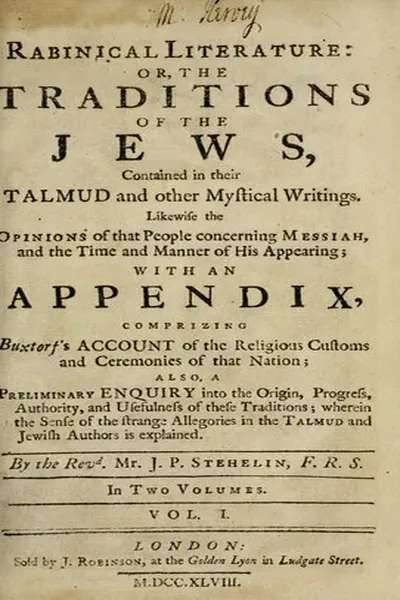
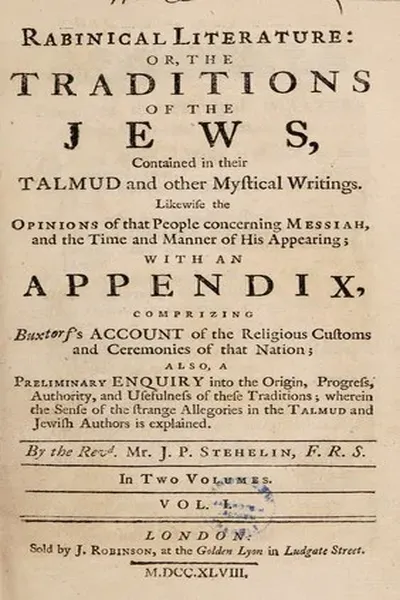
Johann Andreas Eisenmenger, born in Mannheim in 1654, was a German orientalist scholar who became infamous for his work "Entdecktes Judenthum" (Judaism Unmasked). Published posthumously in 1711 and 1714, this two-volume treatise aimed to expose what Eisenmenger alleged were secret and malevolent Jewish practices, asserting that Judaism was a fabricated religion designed to deceive the world. His research into rabbinical literature, which spanned nearly two decades and involved studying with Jewish scholars under the guise of conversion, provided the basis for his controversial claims. Despite attempts by prominent Jewish figures like Samuel Oppenheimer and Samson Wertheimer to ban the book, it was eventually suppressed by imperial decree, though it later saw a new edition printed in 1711.
Eisenmenger's methodology involved extensive citations from Jewish texts, including rabbinical tracts, legal issues, Kabbalah, and polemics, which he presented with German translations. While some scholars describe his approach as rigorous, others have noted its literalist and non-contextual nature. He drew heavily on works by Jewish converts to Christianity to support his charges. The book significantly impacted European perceptions of Jews throughout the 18th and 19th centuries, becoming an early example of modern antisemitism and contributing to negative stereotypes. Its extensive documentation and use of primary sources have made it a persistent, albeit controversial, reference for antisemitic arguments.
Scholarly Pursuits and Early Influences
Born in Mannheim in 1654, Johann Andreas Eisenmenger received a strong education despite losing his father at a young age. He developed a profound interest in Hebrew and Semitic languages at Heidelberg's Collegium Sapientiae, eventually mastering Hebrew, Arabic, and Aramaic. His academic pursuits were supported by the Elector of the Palatinate, who sent him to England and Holland for further study. Eisenmenger dedicated approximately 19 years to studying rabbinical literature, working with Jewish scholars in Heidelberg and Frankfurt. Rumors suggested he feigned interest in converting to Judaism during this period. In Holland, he formed relationships with prominent rabbis, including David ben Aryeh Leib of Lida. An intended journey to Palestine was cut short by the death of his patron in 1680. Later accounts, possibly apocryphal, suggest his anti-Jewish views were shaped by alleged anti-Christian statements made by Rabbi David Lida in Amsterdam and by his reaction to Christians converting to Judaism.
Entdecktes Judenthum: Content and Reception
Eisenmenger's magnum opus, "Entdecktes Judenthum" (Judaism Unmasked), published posthumously in 1711 and 1714, was a comprehensive work intended to expose perceived nefarious aspects of Judaism. He claimed Judaism was a deceptive religion created by ancient Israelites. The book meticulously cited Jewish sources, including rabbinical writings, legal texts, Kabbalah, and polemics, presenting them with German translations. While some characterize his research as scholarly, others point to its literalist and decontextualized approach. Eisenmenger utilized works by Jewish converts to Christianity to reinforce his arguments. The Elector Johann Wilhelm supported Eisenmenger, appointing him professor of Oriental languages at Heidelberg. Eisenmenger advocated for measures against Jews, such as restricting their economic freedoms and banning their religious practices. The book aimed to shock enlightened Jews and persuade them towards Christianity, while also appealing to a secular audience.
Suppression and Lasting Impact
The publication of "Entdecktes Judenthum" faced significant opposition. Financier Samuel Oppenheimer, fearing increased prejudice against Jews, denounced the work as libelous and attempted to have it suppressed. His rival, Samson Wertheimer, later successfully petitioned Emperor Leopold I to ban the book, leading to the confiscation of the entire initial print run of 2,000 copies. Despite rumors of a bribe offered to Eisenmenger to suppress his work, no transaction occurred. Eisenmenger died suddenly in 1704, with some attributing it to grief over his book's suppression. However, in 1711, King Frederick William I of Prussia ordered a new edition printed at his own expense, circumventing imperial prohibitions by listing Königsberg as the publication site. The original edition was released nearly forty years later. Eisenmenger's work remains a highly documented, yet controversial, text, providing extensive citations that have been instrumental for antisemitic arguments throughout history. Scholars acknowledge his deep knowledge of Jewish sources, noting he did not falsify them but interpreted them tendentiously.
Key Ideas
- Judaism is a false religion invented to deceive the world.
- Jews engage in secret and nefarious practices.
- Proposed restrictions on Jewish economic liberties and religious practices.
- Promoted conversion of Jews to Christianity.
Notable Quotes
“Eisenmenger proceeded to amass quotations from the Talmud and other Hebrew sources revealing to all how the Jewish religion was barbarous, superstitious, and even murderous.”
“While piously insisting that the Jews must not be converted by cruel methods, Eisenmenger blithely recommended abolishing their present 'freedom in trade,' which was making them 'lords' over the Germans.”
“Eisenmenger demanded too an immediate ban on their synagogues, public worship, and communal leaders and rabbis.”
“Eisenmenger was acquainted with all the literature a Jewish scholar of standing would have known ... [He] surpassed his [non-Jewish] predecessors in his mastery of the sources and his ability to interpret them tendentiously.”
“Eisenmenger neither forged his sources nor pulled his accusations out of thin air. There was a nucleus of truth in all his claims: the Jews lived in a world of legendary or mythical concepts, of ethical duality-following different standards of morality in their internal and external relationships- and they dreamed with imaginative speculation of their future in the time of the Messiah. Similare claims, however, could have been made against the Christian as well.”
Books by Johann Andreas Eisenmenger
2 free public domain books · Read online or download