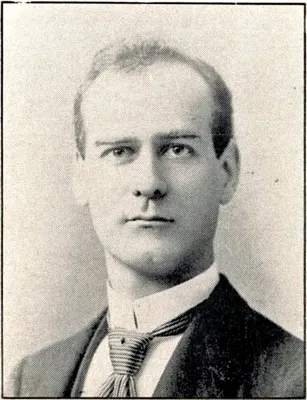
Jesse Charles Fremont Grumbine
Jesse Charles Fremont Grumbine was a Spiritualist author and organizer who founded institutions for psychic study and spiritual development.
Jesse Charles Fremont Grumbine (1861–1938) was an American author, lecturer, and organizer prominent in the Spiritualist and New Thought movements. Initially an ordained minister in the Universalist and later Unitarian traditions, Grumbine left the clergy in the 1890s to fully embrace Spiritualism. He became a significant figure through his extensive writings and public lectures on topics such as clairvoyance, telepathy, and psychometry.
Grumbine was best known for establishing key organizations dedicated to the exploration of psychic phenomena and spiritual growth. These included the College of Psychical Science and Unfoldment, which offered instruction through mail-based lessons in various metaphysical subjects, and the Order of the White Rose, a Rosicrucian organization focused on a "Universal Religion" that emphasized inner spiritual development over external dogma. His work aimed to present spiritual truths in a clear, scientific manner, distinguishing it from what he perceived as the excessive mysticism in contemporary occult literature.
Early Ministry and Transition to Spiritualism
Born in 1861, Jesse Charles Fremont Grumbine received theological education and began his ministry as a Universalist, later serving Unitarian congregations. During his pastorate in Syracuse, New York, his public support for Henry George's political and economic ideas led to conflict with the Universalist Church Society, ultimately prompting his departure from the congregation. Following this, Grumbine transitioned to the Unitarian ministry. However, by 1894, a profound shift in his beliefs led him to leave the Unitarian clergy altogether. He publicly declared his commitment to Spiritualism, dedicating himself to its study and teaching, and began traveling extensively to lecture on its doctrines and phenomena.
Founding of the College of Psychical Science and Unfoldment
In 1894, Grumbine established the College of Psychical Science and Unfoldment, an institution he described as unique at the time, dedicated to his "System of Philosophy Concerning Divinity." The college provided instruction via mailed lessons in subjects like metaphysics, clairvoyance, psychometry, telepathy, and suggestive therapeutics. Headquartered in Chicago from 1898, it featured faculty associated with Spiritualism and mental science, including W. J. Colville and Dr. Herbert A. Parkyn. Grumbine aimed to present psychical research scientifically, contrasting with what he saw as the obscure language and excessive mysticism in much occult writing. He emphasized personal development and mental discipline over speculative mysticism, viewing sensory experiences like color as reflections of spiritual laws.
The Order of the White Rose and Universal Religion
Grumbine also founded the Order of the White Rose in 1893, a Rosicrucian organization that served as the headquarters for the College. The Order promoted his concept of "Universal Religion," asserting that divine truth is universal and accessible through inner spiritual development rather than external religious structures. It taught that spirit is the fundamental reality and that personal consciousness is the primary source of religious insight, viewing figures like Jesus and Buddha as exemplars of this singular, universal truth. Grumbine claimed inspiration for the Order's teachings came partly from communications he believed he received from the spirit of Elizabeth Barrett Browning.
Key Ideas
- Spiritualism as a system of truth and love, emphasizing gradual personal growth.
- Salvation through individual effort and moral development, not church authority.
- Spiritual communication via thought transference, with spirits remaining in the spirit realm.
- The body as a temporary vessel governed by spiritual laws.
- Universal Religion: divine truth transcends sectarian boundaries and is realized through inner development.
- Distinguishing serious psychical research from excessive mysticism.
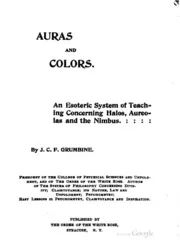
- Color as a vibratory expression or aura corresponding to an individual's condition.
- Consciousness as the medium for divine impressions, with the brain acting as a reflector of thought.
Books by Jesse Charles Fremont Grumbine
3 free public domain books · Read online or download