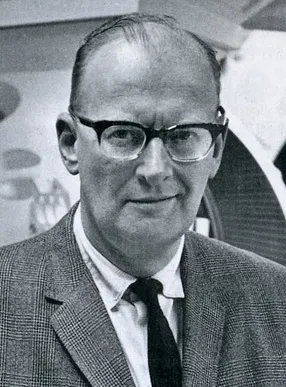
Jeffrey Clarke
Arthur C. Clarke was a visionary science fiction author, futurist, and science popularizer known for his space age prophecies.
Arthur C. Clarke was an English author, futurist, and popularizer of science, widely recognized for his contributions to science fiction and his forward-thinking ideas about space travel. Born in 1917, he developed an early interest in astronomy and science fiction, which he pursued throughout his life. Clarke served as a radar specialist in the Royal Air Force during World War II. After the war, he earned degrees in mathematics and physics and became a prominent figure in the British Interplanetary Society, proposing the concept of geostationary satellites for telecommunications. His influential science fiction works, such as "2001: A Space Odyssey," earned him numerous awards and cemented his status as a "Prophet of the Space Age." Clarke later relocated to Sri Lanka, where he pursued his passion for undersea exploration, discovered ancient temple ruins, and hosted television programs exploring mysterious phenomena. He received several honors for his cultural and scientific contributions before his death in 2008.
Early Life and Influences
Arthur Charles Clarke was born in Minehead, Somerset, England. His childhood on a farm fostered an early fascination with stargazing, fossils, and American science fiction magazines. Influenced by items like "Amazing Stories" and books such as Olaf Stapledon's "Last and First Men," Clarke developed a profound interest in science fiction. During his teenage years, he joined the Junior Astronomical Association and contributed articles on spacecraft and space travel to its journal, "Urania." After moving to London in 1936, he worked for the Board of Education while sharing a flat with fellow science fiction writers, where he earned the nickname "Ego."
Wartime Service and Scientific Contributions
During World War II, Clarke served in the Royal Air Force as a radar specialist from 1941 to 1946. He played a role in the early-warning radar defense system crucial to the Battle of Britain and focused on ground-controlled approach (GCA) radar, which later proved vital for the Berlin Airlift. After the war, he pursued higher education, earning a first-class degree in mathematics and physics from King's College London. He then worked as an assistant editor for "Physics Abstracts." Clarke also served as president of the British Interplanetary Society multiple times. In 1945, he proposed the concept of geostationary satellites as ideal telecommunications relays, a foundational idea that led to the "Clarke Orbit" being named in his honor.
Literary Career and Space Age Vision
Clarke is celebrated as one of the "Big Three" science fiction writers, alongside Robert Heinlein and Isaac Asimov. His prolific output of novels and essays popularized space travel and earned him critical acclaim, including Hugo and Nebula Awards. His screenplay for the influential 1968 film "2001: A Space Odyssey," co-written with Stanley Kubrick, further cemented his legacy. Clarke's writings, such as "The Exploration of Space," were instrumental in convincing leaders like President John F. Kennedy of the feasibility of space missions. He was recognized with the Kalinga Prize by UNESCO for his work in popularizing science, earning him the moniker "Prophet of the Space Age."
Life in Sri Lanka and Later Years
In 1956, Clarke relocated to Ceylon (now Sri Lanka) to indulge his passion for scuba diving. He discovered underwater ruins of an ancient temple near Trincomalee, documented in his book "The Reefs of Taprobane." He became a prominent resident, hosting television series like "Arthur C. Clarke's Mysterious World" in the 1980s, which explored unexplained phenomena. Clarke received significant honors, including Commander of the Order of the British Empire (CBE) and a knighthood, as well as Sri Lanka's highest civil honor, the Sri Lankabhimanya. He remained in Sri Lanka until his death in 2008, becoming a patron of environmental causes and continuing to influence the fields of science and speculative fiction.
Key Ideas
- Concept of geostationary satellites for telecommunications relays (later named the Clarke Orbit).
- Popularization of space travel and its scientific and societal implications.
- Exploration of mysterious phenomena and the unknown in television series.
Notable Quotes
“No, merely mildly cheerful.”
Books by Jeffrey Clarke
2 free public domain books · Read online or download