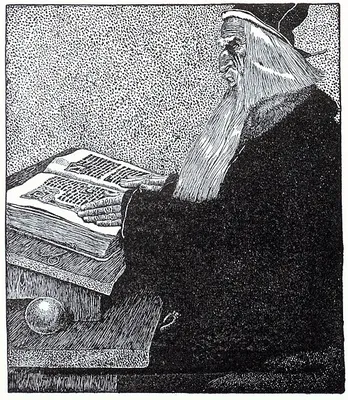
Jean Markale
Jean Markale proposed Merlin's name originates from French, meaning 'little blackbird,' reflecting his provocative medieval persona.
The figure of Merlin, central to Arthurian legend, was largely shaped by 12th-century cleric Geoffrey of Monmouth, who blended Welsh tales of prophets Myrddin and Emrys into a composite character, Merlinus Ambrosius. This figure, initially a prophet and royal advisor, gained immense popularity and was further developed by later writers into a multifaceted magician and sage. Merlin's traditional biography describes him as a cambion, born of a mortal woman and an incubus, inheriting supernatural abilities like prophecy and shapeshifting. He is known for engineering Arthur's birth and serving as his advisor before disappearing, often with prophecies foretelling future events. Various legends detail his end, including being enchanted or killed by the Lady of the Lake.
The etymology of Merlin's name is debated. While derived from the Welsh Myrddin, Geoffrey's Latinization to Merlinus may have aimed to avoid an association with the Latin word for feces. Folklorist Jean Markale suggested a French origin for the name, meaning 'little blackbird,' alluding to the character's often mocking nature in medieval stories. Other theories connect Myrddin to 'madman' or 'myriad names,' or to the Welsh town of Carmarthen. Parallels have also been drawn between Merlin's attributes and those of Saint Martin of Tours, though the direction of influence is uncertain.
Origins and Development of the Merlin Figure
The iconic image of Merlin emerged primarily through the work of Geoffrey of Monmouth in the 12th century. Geoffrey synthesized existing Welsh legends, notably those of the prophets Myrddin and Emrys, to create a composite figure named Merlinus Ambrosius. Initially presented as a prophet and advisor to King Uther Pendragon, this character quickly resonated, particularly in Wales. Subsequent French romances and chronicles expanded upon Geoffrey's foundation, imbuing Merlin with a more complex personality and magical prowess, establishing him as a pivotal figure in medieval literature and imagination. His legend continued to evolve, incorporating elements of ancient Celtic traditions and Christian influences, presenting him as a sage gifted with profound wisdom and prophecy.
Etymological and Mythological Interpretations of Merlin's Name
The name 'Merlin' is derived from the Welsh 'Myrddin,' a name Geoffrey of Monmouth Latinized. Speculation exists that Geoffrey altered the name to avoid an unfavorable association with the Latin word 'merda.' Folklorist Jean Markale proposed a French origin for the name, interpreting it as 'little blackbird,' which he linked to Merlin's frequently depicted mocking and provocative personality in medieval tales. Other etymological theories suggest 'Myrddin' could mean 'madman' or derive from a word signifying 'myriad.' A notable theory connects the name to the Welsh town of Carmarthen (Caerfyrddin), although this is debated against the possibility that the town was named after the bard. Parallels in attributes have been noted between Merlin and Saint Martin of Tours, though the historical connection remains unclear.
Merlin's Biographical Archetype and Supernatural Attributes
The traditional biography of Merlin portrays him as a cambion, the offspring of a human mother and an incubus, a union from which he inherits his extraordinary supernatural abilities. Among his most recognized powers are prophecy and shapeshifting. The narrative arc often depicts Merlin maturing into a wise sage who utilizes magic and strategic planning to facilitate the conception of King Arthur. He subsequently serves as a mentor and advisor to the young king. His eventual departure from the Arthurian narrative is frequently marked by mysterious circumstances, leaving behind prophecies that foretell future events. Alternative versions of his end describe him being magically imprisoned or slain by the Lady of the Lake, whom he had fallen in love with, or simply retiring from the world.
Key Ideas
- Merlin as a composite figure created by Geoffrey of Monmouth
- Merlin's birth as a cambion (half-human, half-demon)
- Merlin's supernatural abilities: prophecy and shapeshifting
- Merlin's role in the conception and mentorship of King Arthur
- Debated etymology of the name 'Merlin'
Books by Jean Markale
2 free public domain books · Read online or download