Jean-Jacques Rousseau
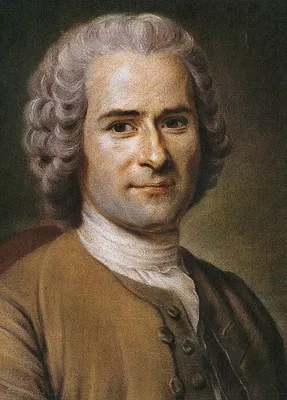
Jean-Jacques Rousseau was a Genevan philosopher whose ideas profoundly shaped Enlightenment thought, political theory, and literature.
Jean-Jacques Rousseau, born in Geneva in 1712, was a philosopher, writer, and composer whose work significantly impacted the Age of Enlightenment and subsequent political and intellectual movements. His early life in Geneva, a city with a complex political structure and strong Calvinist roots, informed his later critiques of social and political inequality. Despite his family's middle-class status, Rousseau was proud of his Genevan citizenship. His mother died shortly after his birth, and he was raised by his father and aunt, experiencing a childhood marked by storytelling, early exposure to classical texts like Plutarch, and observations of Genevan civic life and artisan culture.
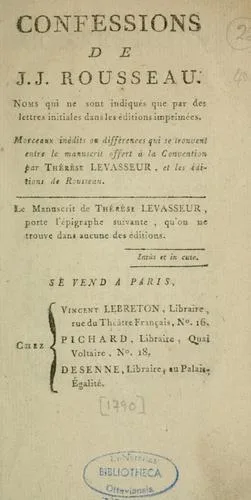
Rousseau's intellectual contributions include foundational texts in political philosophy, such as 'Discourse on Inequality,' which identified private property as a source of societal disparity, and 'The Social Contract,' which proposed principles for a just political system. His literary works also left a lasting mark; 'Julie, or the New Heloise' was instrumental in the development of romantic literature, while 'Émile, or On Education' explored the individual's place within society. His autobiographical writings, notably 'Confessions,' pioneered modern autobiography, emphasizing subjectivity and introspection.
Genevan Roots and Early Influences
Born in Geneva, a city-state with a history of Calvinism and a complex democratic structure, Rousseau's lineage included booksellers and watchmakers. He took pride in his family's 'moyen order' status and his rights as a 'Citizen of Geneva.' However, Geneva's governance was largely controlled by a wealthy oligarchy, a reality that fueled political debate among its citizens, including artisans. Rousseau's father, Isaac, was a well-educated watchmaker with an appreciation for music, who instilled in young Jean-Jacques a love for reading. Early reading of adventure romances and classical works like Plutarch's Lives significantly shaped Rousseau's worldview, fostering a 'free and republican spirit' and romantic notions about life. His childhood was also marked by familial complexities, including his mother's early death and a fabricated family history, as well as observations of civic participation and the distinct social strata within Geneva.
Philosophical and Literary Impact
Rousseau's philosophical writings laid crucial groundwork for modern political and social thought. His 'Discourse on Inequality' posited that private property was the origin of social stratification and inequality. 'The Social Contract' further explored the foundations of a legitimate political order, advocating for popular sovereignty. These works profoundly influenced the Enlightenment and subsequent revolutions. Beyond political theory, Rousseau's literary contributions were also significant. His novel 'Julie, or the New Heloise' played a key role in the emergence of preromantic and romantic literary styles. His educational treatise, 'Émile, or On Education,' examined the development of the individual within societal contexts. Furthermore, his autobiographical works, 'Confessions' and 'Reveries of the Solitary Walker,' are considered foundational to modern autobiography, highlighting a new focus on personal experience, introspection, and subjectivity.
Key Ideas
- Private property as the source of social inequality
- Principles for a legitimate political order based on popular sovereignty
- The individual's place and education within society
- Emphasis on subjectivity and introspection in autobiographical writing
Notable Quotes
“A sovereign that never performs an act of sovereignty is an imaginary being”
“I was born almost dying, they had little hope of saving me”
“the first of my misfortunes”
“A Genevan watchmaker is a man who can be introduced anywhere; a Parisian watchmaker is only fit to talk about watches”
“those important persons who are called artists rather than artisans, work solely for the idle and rich, and put an arbitrary price on their baubles”
Books by Jean-Jacques Rousseau
0 free public domain books · Read online or download