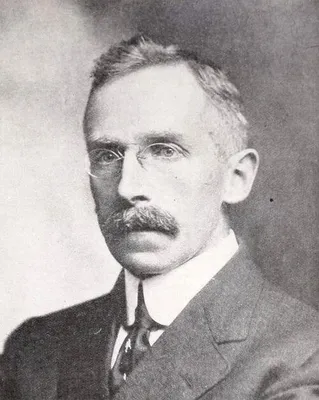
James Harvey
James Harvey Robinson was a historian who pioneered 'New History,' emphasizing social progress over political events.
James Harvey Robinson (1863–1936) was an American historian known for co-founding the "New History" movement with Charles Austin Beard. This approach sought to understand contemporary issues by examining history through the lens of social sciences, broadening the field beyond mere political narratives. Robinson's academic career included positions at the University of Pennsylvania and Columbia University, where he mentored many influential students. Following faculty disputes at Columbia, he became a founding director of the New School for Social Research in 1919.
Robinson's influential writings and lectures championed the "New History," focusing on societal, scientific, and intellectual advancements rather than solely political occurrences. His textbook, "An Introduction to the History of Western Europe," was highly praised for its scholarly depth and engaging style, revolutionizing the teaching of European history. His bestseller, "The Mind in the Making," introduced readers to intellectual concepts and argued for intellectual freedom, suggesting that people often use rationalizations instead of genuine reasoning. Despite his impact, Robinson's ideas faced criticism from some classical scholars.
The New History Movement
James Harvey Robinson was a leading proponent of the "New History," a significant shift in historical scholarship. Alongside Charles Austin Beard, he advocated for a broader understanding of history, integrating insights from social sciences to address present-day challenges. This methodology moved beyond a focus on political events to encompass social, scientific, and intellectual progress. Robinson's influence extended through his editorial roles with "The Annals of the American Academy of Political and Social Science" and the "American Historical Review," as well as his presidency of the American Historical Association. His commitment to making history relevant to contemporary life was a hallmark of his career.
Impact on Historical Pedagogy
Robinson significantly impacted how history was taught and understood. His "An Introduction to the History of Western Europe," first published in 1902, was lauded for its scholarly rigor, engaging tone, and insightful interpretations, fundamentally changing the teaching of European history for a generation. Furthermore, his 1921 book, "The Mind in the Making: The Relation of Intelligence to Social Reform," became a bestseller, popularizing complex intellectual ideas for a wider audience. The book championed intellectual freedom as crucial for societal advancement and proposed that human reasoning is often supplanted by rationalizations. This work, along with the "New History" movement itself, aimed to reform historical study, making it a more useful and dynamic discipline.
Later Reflections and Criticism
In his final book, "The Human Comedy: As Devised and Directed by Mankind Itself" (1937), Robinson offered his developed thoughts on history after a long career. While historians like Jay Green recognized Robinson's efforts to reform historical methodology and pedagogy, making history relevant and useful for contemporary understanding and social improvement, others offered a more skeptical view. For instance, Jack Pole noted that the impact of the "New History" school was not universally embraced, with some historians continuing traditional approaches, and that its influence waned by the end of World War II. Critics, such as Paul Shorey, also challenged Robinson's approach, particularly his popularization of historical ideas, suggesting a potential disregard for rigorous historical proof in favor of narrative.
Key Ideas
- New History: A disciplinary approach using history to understand contemporary problems by broadening its scope to include social sciences.
- Emphasis on social, scientific, and intellectual progress over mere political happenings.
- The mind's tendency to substitute rationalizations for reason.
- The importance of intellectual freedom for societal progress.
Notable Quotes
“history is written in the narrative, not proven”
Books by James Harvey
2 free public domain books · Read online or download