James H. Schmitz
James H. Schmitz was a German-American sci-fi author known for space opera and strong female characters with psionic abilities.
James Henry Schmitz, born in Germany to American parents in 1911, was a science fiction writer whose career spanned over two decades. He developed a bilingual upbringing and lived in both Germany and the United States, experiencing the economic hardships of the Great Depression and serving as an aerial photographer during World War II. Schmitz primarily wrote short stories, finding a significant audience in magazines like Galaxy Science Fiction and Astounding Science-Fiction. He is particularly recognized for his contributions to the space opera genre and for creating memorable female protagonists who defied common stereotypes of the era, often possessing telepathic or other psionic powers. His work has been lauded for its nuanced characters and its depiction of diverse universes.
Schmitz's writing is often associated with his "Hub" series, which frequently featured characters with telepathic abilities. His novel, The Witches of Karres, about young individuals with psi-powers escaping slavery, is considered by many to be his finest work and received a Hugo Award nomination. Critics have noted his skill in crafting complex, psychologically rich characters, even his antagonists, and his universes are described as places where ordinary life is possible alongside extraordinary adventures. His progressive portrayal of women in leading roles, decades before the mainstream feminist movement, has also been highlighted as a significant aspect of his legacy, influencing subsequent generations of science fiction authors.
Writing Style and Themes
James H. Schmitz established himself as a prominent voice in science fiction, primarily through his prolific output of short stories. He is best known for his "space opera" narratives, characterized by interstellar adventures and often featuring characters with psionic abilities, particularly telepathy. A hallmark of his work is the creation of strong, capable female protagonists, such as Telzey Amberdon and Trigger Argee. These characters consistently defied the "damsel in distress" trope prevalent in much of the science fiction of his time, demonstrating independence, resourcefulness, and significant power. Schmitz's universes, while populated with dangers and challenges, are often depicted as having room for ordinary, decent lives, reflecting a tolerant attitude towards alien species and their motivations, which stood in contrast to the more xenophobic tendencies found in some contemporary tales.
Notable Contributions and Recognition
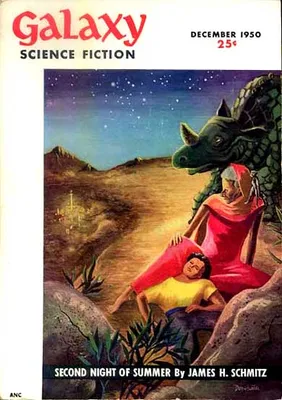
Schmitz's story "Second Night of Summer" is notable for introducing the term "hive mind" into science fiction literature. His novel The Witches of Karres, which explores themes of psychic powers and escape from oppression, is frequently cited as his magnum opus and earned a Hugo Award nomination. Critics like Gardner Dozois and John Clute have praised Schmitz for his sophisticated character development, noting his ability to craft complex villains and his egalitarian portrayal of men and women. His work, particularly the "Hub" series and collections like Agent of Vega, has been reissued, ensuring continued readership and appreciation for his unique contributions to the genre. His influence is seen in his paving the way for later authors who centered their stories on female leads.
Early Life and Career Path
Born in Hamburg, Germany, to American parents, James Henry Schmitz received a bilingual education. His family's movements during World War I saw them residing in the United States before returning to Germany. Schmitz's early career aspirations led him to Chicago for business school, followed by a journalism correspondence course. However, the economic downturn of the Great Depression hindered his job prospects, prompting his return to Germany to work for his father's company, International Harvester. He lived and worked in various German cities until his family's departure shortly before the outbreak of World War II, during which he served as an aerial photographer for the U.S. Army Air Forces.
Key Ideas
- Space opera featuring strong, independent female protagonists.
- Exploration of psionic abilities, including telepathy and psi-powers.
- Introduction of the term "hive mind" in science fiction.
- Complex characterization, including nuanced villains.
- Tolerant depiction of alien species and their motivations.
Notable Quotes
“Although he lacked van Vogt's paranoid tension and ornately Byzantine plots, the late James H. Schmitz was considerably better at people than van Vogt was, crafting even his villains as complicated, psychologically complex, and non-stereotypical characters, full of surprising quirks and behaviors that you didn't see in a lot of other Space Adventure stuff.”
“And his universes, although they come with their own share of monsters and sinister menaces, seem as if they would be more pleasant places to live than most Space Opera universes, places where you could have a viable, ordinary, and decent life once the plot was through requiring you to battle for existence against some Dread Implacable Monster; Schmitz even has sympathy for the monsters, who are often seen in the end not to be monsters at all, but rather creatures with agendas and priorities and points-of-view of their own, from which perspectives their actions are justified and sometimes admirable—a tolerant attitude almost unique amidst the Space Adventure tales of the day, most of which were frothingly xenophobic.”
“From 1949, when "Agent of Vega" appeared in ASF as the first of 4 stories later assembled as Agent of Vega (collection of linked stories 1960), he regularly produced the kind of tale for which he remains most warmly remembered: Space Opera adventures, several featuring female Heroes depicted with minimum recourse to their "femininity" – they perform their active tasks, and save the Universe when necessary, in a manner almost completely free of sexual role-playing clichés. Most of his best work shares a roughly characterized common background, a Galaxy inhabited by humans and aliens with room for all and numerous opportunities for discoveries and reversals that carefully fall short of threatening the stability of that background. Many of his stories, as a result, focus less on moments of Conceptual Breakthrough than on the pragmatic operations of teams and bureaux involved in maintaining the state of things against criminals, monsters and unfriendly species; in this they rather resemble the tales of Murray Leinster, though they are more vigorous and less inclined to punish adventurousness.”
“During the 50s and 60s "Space Opera" and James H. Schmitz were almost synonymous. He was famous for his tales of interstellar secret agents and galactic criminals, and particularly for heroines such as Telzey Amberdon and Trigger Argee. Many of these characters had enhanced "psionic" powers that let them use their minds as well as their weapons to foil their enemies. All of them were resourceful in the best heroic tradition.”
“Schmitz was decades ahead of the curve in his portrayal of female characters—years before the Women's Movement of the '70s would come along to raise the consciousness of SF writers (or attempt to), Schmitz was not only frequently using women as the heroines in swashbuckling tales of interplanetary adventure—itself almost unheard of at the time—but he was also treating them as the total equal of the male characters, every bit as competent and brave and smart (and ruthless, when needs be), without saddling them with any of the "female weaknesses"—like an inclination to faint or cower under extreme duress, and/or seek protection behind the muscular frame of the Tough Male Hero) that would mar the characterization of women by some writers for years to come. (The Schmitz Woman, for instance, is every bit as tough and competent as the Heinlein Woman—who, to be fair, isn't prone to fainting in a crisis either—but without her annoying tendency to think that nothing in the universe is as important as marrying Her Man and settling down to have as many babies as possible.)”
Books by James H. Schmitz
2 free public domain books · Read online or download