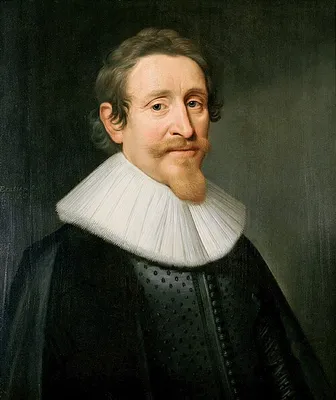
J. J. M. de Groot
Hugo Grotius was a Dutch scholar and diplomat whose legal and philosophical writings laid foundations for international law and modern concepts of rights.
Hugo Grotius, also known as Hugo de Groot, was a Dutch humanist, lawyer, theologian, and statesman of the 16th and 17th centuries. A child prodigy, he studied at Leiden University and later became involved in the political and religious controversies of the Dutch Republic. His involvement in these disputes led to his imprisonment and eventual escape, after which he wrote many of his significant works in exile in France.
Grotius is recognized as a foundational figure in international law, with his works, particularly "De jure belli ac pacis" (On the Law of War and Peace) and "Mare Liberum" (The Free Seas), shaping the understanding of international relations and maritime law. He is credited with articulating the idea of a society of states governed by law rather than force. Beyond law, Grotius also made contributions to theological debates and influenced the evolving concept of individual rights, shifting the perception from object-based rights to person-based abilities.
Early Life and Education
Born in Delft in 1583, Hugo Grotius was the son of a learned father who ensured his early education in humanist and Aristotelian traditions. A precocious talent, Grotius entered Leiden University at the age of eleven, studying under prominent intellectuals of the time. His intellectual prowess was recognized early; at sixteen, he published his first scholarly work, an edition of Martianus Capella's "Satyricon." He accompanied a diplomatic mission to France at fifteen, where he was presented to King Henri IV as a prodigy. During his time in France, he obtained a law degree. Returning to Holland, he began his legal career and was appointed official historiographer for the States of Holland, tasked with chronicling the Dutch revolt against Spain.
Foundations of International Law
Grotius's involvement in a legal case concerning the seizure of a Portuguese ship in 1604 led him to formulate early theories on international justice. His treatise "De Indis" (On the Indies), though not fully published in his lifetime, explored the natural principles governing the lawfulness of war. He is most famously known for "Mare Liberum" (The Free Seas), published in 1609, which established the principle that the seas were international territory open to all nations for trade. This work provided a crucial ideological basis for Dutch maritime trade expansion. Grotius's ideas on the freedom of the seas, while building on earlier concepts, significantly influenced subsequent international maritime law and persisted for centuries.
Political and Theological Contributions
Beyond his legal scholarship, Grotius held significant political positions, serving as an advisor and later as Pensionary of Rotterdam. His diplomatic missions, including one to London regarding the seizure of Dutch ships, highlighted his role in international affairs. Grotius was also deeply involved in the theological controversies of his time, particularly the Arminian-Calvinist debate. His theological positions, especially his defense of Arminianism, influenced later religious movements. His contributions extended to the evolving understanding of rights, proposing a shift from rights attached to objects to rights inherent in individuals, seen as an ability to act or achieve goals.
Key Ideas
- Foundational principles of international law
- Freedom of the seas (Mare Liberum)
- Concept of an international society governed by law
- Shift in the understanding of rights from object-based to person-based
Books by J. J. M. de Groot
2 free public domain books · Read online or download