J. F. C. Fuller
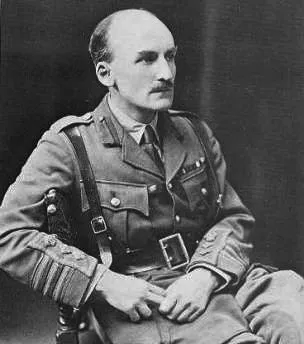
J. F. C. Fuller was a British Army officer, military historian, occultist, and fascist known for his theories on mechanised warfare.
Major-General John Frederick Charles Fuller, known as 'Boney' Fuller, was a prominent British Army officer, military historian, and strategist. He played a significant role in developing tank warfare strategies during World War I, notably contributing to the Battle of Cambrai and conceptualizing Plan 1919 for a fully mechanized offensive. His military theories, emphasizing the potential of tanks and aircraft, significantly influenced military thought in Britain, Germany, and the USA, earning him recognition as a progenitor of blitzkrieg tactics.
Beyond his military career, Fuller was also an ardent occultist and a fervent fascist. After retiring from the army, he became a vocal admirer of Nazism and joined several fascist organizations, including the British Union of Fascists. His political activism extended to involvement in coup plots against the British government, though he avoided internment. Fuller's life was marked by a dual focus on advanced military strategy and esoteric beliefs, alongside his controversial political affiliations.
Early Life and Military Beginnings
Born in Chichester in 1878, John Frederick Charles Fuller was the son of an Anglican clergyman. After a period living in Lausanne, he returned to England and attended Malvern College before training at the Royal Military College, Sandhurst. His nickname, 'Boney,' is thought to derive from an admiration for Napoleon Bonaparte or his own imperious yet brilliant military demeanor. Fuller was commissioned into the Oxfordshire Light Infantry in 1898 and served in the Second Boer War. His experiences in South Africa and later with volunteer units in England, particularly his role in forming the 10th Middlesex, inspired him to deeply study military matters. He entered the Staff College, Camberley, in 1914.
World War I and Military Innovation
During World War I, Fuller served as a staff officer, eventually joining the Headquarters of the Heavy Branch of the Machine-Gun Corps, which became the Tank Corps. He was instrumental in planning the tank assault at the Battle of Cambrai in 1917 and devised Plan 1919, a comprehensive strategy for a fully mechanized offensive against the German army, which was ultimately not implemented due to the war's end. After the war, Fuller collaborated with B. H. Liddell Hart to advocate for the mechanization and modernization of the British Army. He held key instructional and staff positions, including Chief Instructor at the Staff College, Camberley, and a role at the War Office. He was promoted to Major-General in 1930 and retired in December 1933 to focus on his writing.
Political Activism and Fascism
Disillusioned with democratic processes and military reform, Fuller became actively involved in British fascism, joining Sir Oswald Mosley's British Union of Fascists in 1934 and becoming one of Mosley's close associates. He also joined other right-wing and clandestine groups like the Nordic League and the Imperial Fascist League. Fuller traveled to Nazi Germany in 1935 to study the Nazi Party's structure and was present at German army maneuvers. He expressed admiration for Adolf Hitler and believed the Nazis had created a 'scientific' state. His writings and speeches often praised Nazi Germany, and he was an honored guest at Hitler's 50th birthday parade. Fuller was involved in two coup plots against the British government in 1940 but avoided internment.
Occultism and Esoteric Interests
Alongside his military and political activities, Fuller was deeply interested in the occult and esoteric subjects. He delivered a talk titled 'The Hebrew Mysteries' to the Nordic League in March 1939, indicating a focus on mystical and potentially Kabbalistic themes. His involvement with groups like the Nordic League and The Link, which had strong pro-Nazi and anti-Semitic leanings, suggests a confluence of his esoteric interests with his far-right political ideology. While the provided text does not elaborate extensively on the specifics of his occult studies, it clearly marks him as an individual engaged with non-mainstream spiritual and mystical traditions.
Key Ideas
- Progenitor of blitzkrieg
- Emphasis on mechanised warfare (tanks and aircraft)
- Theories on bypassing large enemy forces for eventual encirclement and destruction
Notable Quotes
“I hope you were pleased with your children?”
“Your Excellency, they have grown up so quickly that I no longer recognise them.”
“a bloody revolution”
“The Hebrew Mysteries”
Books by J. F. C. Fuller
4 free public domain books · Read online or download