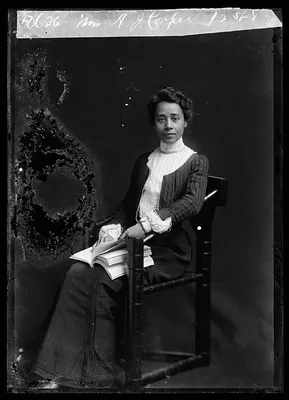
J. C. Cooper
Anna Julia Cooper was a pioneering African American author, educator, and activist who championed Black women's intellectual and social advancement.
Anna Julia Cooper, born into slavery in 1858, rose to become a prominent author, educator, and activist. Despite her early life circumstances, she pursued higher education, earning degrees from Oberlin College and eventually completing her doctorate at the University of Paris at age sixty-six. Cooper was a significant figure in Washington D.C.'s African-American community and is recognized for her foundational contributions to Black feminist thought. Her seminal work, "A Voice from the South," articulated the importance of education and self-determination for Black women, arguing that their intellectual progress would elevate the entire Black community. She advocated for classical education for Black students, a stance that sometimes put her at odds with prevailing vocational approaches. Cooper's life was dedicated to intellectual pursuits and social uplift, leaving a lasting legacy in American letters and activism.
Early Life and Education
Born enslaved in Raleigh, North Carolina, Anna Julia Haywood's early life was marked by the constraints of her status. However, she demonstrated exceptional academic promise from a young age. At nine years old, she received a scholarship to St. Augustine's Normal School and Collegiate Institute, where she excelled in a broad range of subjects, including languages, literature, mathematics, and science. Despite institutional discouragement for women in higher-level studies, Cooper asserted her right to pursue challenging coursework. She continued her education at Oberlin College, where she earned a Bachelor of Arts degree. Following the early death of her husband, George A. C. Cooper, she returned to Oberlin to complete a master's degree in mathematics, becoming one of the first Black women to achieve this distinction. Her academic journey underscored a lifelong commitment to intellectual development and access to education.
Advocacy and "A Voice from the South"
Cooper's intellectual contributions were profoundly shaped by her experiences and observations. Her first book, "A Voice from the South: By a Black Woman of the South," published in 1892, is considered a foundational text of Black feminism. In it, she argued for the critical role of Black women's education and intellectual development in advancing the entire African-American community. She posited that fostering female intellectuals was essential for bringing elegance and a broader perspective to societal progress. While some viewed her ideas as aligning with 19th-century notions of womanhood, her work is widely celebrated for its powerful advocacy for Black women's self-determination and uplift. Cooper also addressed socioeconomic realities and the administration of the Episcopal Church in her writings, demonstrating a comprehensive engagement with the issues facing her community.
Later Career and Doctoral Studies
Throughout her career, Cooper was an active educator and public speaker. She held a position as a teacher and later principal at M Street High School in Washington, D.C. Here, she became involved in a debate over educational philosophy, advocating for a classical curriculum that prepared students for higher education, as opposed to a vocational model. This stance led to a temporary dismissal from her position but she was later reinstated. Cooper also pursued advanced academic endeavors later in life. She began doctoral studies at Columbia University and later transferred credits to the University of Paris, where she completed her Ph.D. at the age of sixty-six, making her one of the earliest African American women to earn a doctorate.
Key Ideas
- The intellectual and educational advancement of Black women is crucial for the progress of the entire African-American community.
- Advocacy for classical education for Black students to prepare them for higher learning and leadership.
- The importance of self-determination and social uplift for Black women.
Notable Quotes
“A nation's greatness is not dependent upon the things it make and uses. Things without thots [sic] are mere vulgarities. America can boast her expanse of territory, her gilded domes, her paving stones of silver dollars; but the question of deepest moment in this nation today is its men and its women, the elevation at which it receives its "vision" into the firmament of eternal truth.”
Books by J. C. Cooper
2 free public domain books · Read online or download