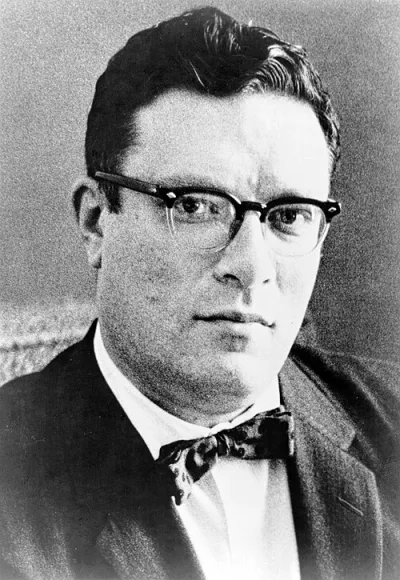
Isaac Asimov
Isaac Asimov was a prolific American author, professor, and science fiction icon known for his expansive future histories and popular science works.
Isaac Asimov, born in Russia and later becoming an American citizen, was a highly prolific writer and a professor of biochemistry. He is widely recognized as one of the foundational figures in science fiction, often grouped with Robert A. Heinlein and Arthur C. Clarke. Asimov's literary output was immense, encompassing over 500 books and tens of thousands of letters. While primarily celebrated for his hard science fiction, his work also spanned genres like mystery and fantasy, alongside extensive non-fiction, including popular science explanations and analyses of works like the Bible and Shakespeare.
His most famous creation is the Foundation series, which reimagined historical patterns of decline and fall in a futuristic setting. Asimov also developed the interconnected Robot and Galactic Empire series, eventually linking them to create a unified future history. Beyond his novels, he authored numerous short stories, including the highly regarded "Nightfall," and wrote juvenile fiction under a pseudonym. His non-fiction often approached scientific concepts by tracing their historical development from their simplest origins. Asimov's influence extended beyond literature, leading to numerous honors, including celestial and robotic designations in his name.
Literary Universe and Themes
Asimov's most significant contribution to science fiction is his interconnected series, notably the Foundation, Galactic Empire, and Robot sagas. The Foundation series, inspired by Edward Gibbon's "The History of the Decline and Fall of the Roman Empire," explored grand societal cycles and the manipulation of history on a galactic scale. The Robot series introduced the famous Three Laws of Robotics, which explored the ethical and practical implications of artificial intelligence and human-robot interaction. Asimov meticulously wove these narratives together, creating a vast, unified "future history" that spanned millennia. His short stories, such as the celebrated "Nightfall," often delved into social science fiction, examining societal reactions to profound scientific or existential discoveries.
Approach to Science and Knowledge
Beyond his fictional worlds, Asimov was a dedicated popularizer of science. His non-fiction works, including "Guide to Science" and "Understanding Physics," characteristically explained complex scientific principles by tracing their historical evolution from their earliest, simplest forms. This approach provided readers with a deep understanding of scientific concepts within their broader historical and intellectual contexts. Asimov also applied this analytical lens to non-scientific subjects, writing extensively on topics ranging from chemistry and astronomy to history, biblical studies, and literary criticism, demonstrating a broad intellectual curiosity and a commitment to making knowledge accessible.
Personal Journey and Identity
Born in Russia to Jewish parents, Isaac Asimov immigrated to the United States as a young child. He taught himself to read and developed an early passion for literature, influenced by the magazines sold in his family's candy stores. Despite facing educational barriers due to ethnic quotas, he pursued higher education, earning degrees in chemistry and eventually becoming a professor of biochemistry at Boston University. Asimov's Jewish heritage and immigrant experience subtly informed his worldview, and he later became president of the American Humanist Association. He embraced his unique surname, which derived from his family's history with grain, and famously resisted suggestions to use a pseudonym, believing his distinctive name aided his career.
Key Ideas
- Three Laws of Robotics
- Unified future history connecting Robot, Galactic Empire, and Foundation series
- Historical approach to popular science explanation
- Psychohistory (implied through Foundation series' themes)
Books by Isaac Asimov
3 free public domain books · Read online or download