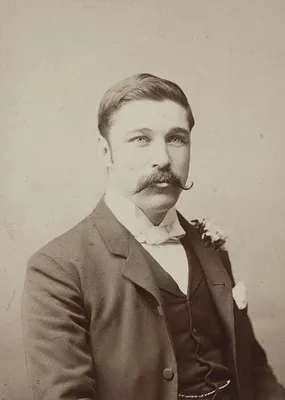
Hume, Fergus
Fergus Hume was a prolific English novelist known for his detective fiction, most famously 'The Mystery of a Hansom Cab'.
Fergus Hume, born Ferguson Wright Hume in 1859, was an English novelist primarily recognized for his contributions to detective fiction, thrillers, and mysteries. His early life saw him emigrate from England to New Zealand with his family, where he pursued legal studies and was admitted to the bar. He later relocated to Melbourne, Australia, working as a barrister's clerk.
Hume gained significant recognition with his self-published novel, 'The Mystery of a Hansom Cab,' in 1886. This work, set in Melbourne and drawing on his observations of urban life, became a phenomenal success, earning the title of the best-selling mystery novel of the Victorian era and even inspiring Arthur Conan Doyle. Despite its success, Hume's financial benefit was limited due to the early sale of British and American rights. He returned to England in 1888 and continued to write prolifically, publishing over 130 novels, though none achieved the same level of fame as his debut. He lived for many years in Thundersley, Essex, where he also contributed lyrics to songs and wrote book reviews. Hume died in 1932, leaving behind a substantial body of work.
Early Life and Emigration
Ferguson Wright Hume, known to the public as Fergus Hume, was born on July 8, 1859, in Powick, Worcestershire, England. He was the second son of James Hume, a Scot who worked as a clerk and steward at a county asylum. In 1863, the Hume family journeyed to Dunedin, New Zealand, where his father established Ashburn Hall, an institution for the mentally ill. Young Fergus received his education at Otago Boys' High School and went on to study law at the University of Otago. He qualified as a barrister in New Zealand in 1885. Following his graduation, Hume moved to Melbourne, Australia, securing employment as a clerk for a barrister.
Rise to Prominence and 'The Mystery of a Hansom Cab'
Hume's literary career gained traction after a play he authored, 'The Bigamist,' was appropriated by an individual named Calthorpe, who presented it as his own under the title 'The Mormon.' Hume's most notable work, 'The Mystery of a Hansom Cab,' was set in Melbourne and featured vivid descriptions of impoverished urban areas, informed by his familiarity with Little Bourke Street. Self-published in 1886, the novel achieved immense popularity, becoming the best-selling mystery novel of the Victorian era. Literary critic John Sutherland later described it as the "most sensationally popular crime and detective novel of the century." The novel's success is credited with inspiring Arthur Conan Doyle to write 'A Study in Scarlet,' which introduced Sherlock Holmes. Despite its critical and commercial triumph, Hume received only £50 for the British and American rights, limiting his financial gains. The book was also adapted into a stage play.
Later Life and Literary Output
Following the success of his debut novel and another publication, 'Professor Brankel's Secret' (circa 1886), Hume relocated back to England in 1888. His third novel, 'Madame Midas,' drew inspiration from the life of mine and newspaper owner Alice Ann Cornwell. The novel's subsequent adaptation into a play led to a lawsuit from her estranged husband, John Whiteman, concerning its content. Hume eventually settled in Thundersley, Essex, residing at Church Cottage for approximately thirty years. During this period, he was exceptionally prolific, producing over 130 novels and several collections, predominantly in the mystery genre, although he never replicated the initial success of 'The Mystery of a Hansom Cab.' He also contributed lyrics for songs composed by his brother-in-law, Charles Willeby, and penned book reviews for literary publications such as 'The Bookman.' The 1911 census recorded him as an author living in Thundersley with a housekeeper. He was known to travel extensively throughout Europe. Later in life, Hume moved to 'Rosemary Cottage' in Thundersley after the death of his patron, Reverend Thomas Noon Talfourd Major. Scholars now suggest Hume was likely homosexual, citing his close relationships with several men, including Major, and a past incident of blackmail involving an actor imprisoned for indecent assault. Despite a reputation for being deeply religious and private, he engaged in lecturing at youth clubs in his later years. Hume passed away in Thundersley on July 12, 1932, and is buried in an unmarked grave.
Notable Quotes
“Hansom Cab was a slight tale, mostly sold by 'puffing'.”
Books by Hume, Fergus
2 free public domain books · Read online or download