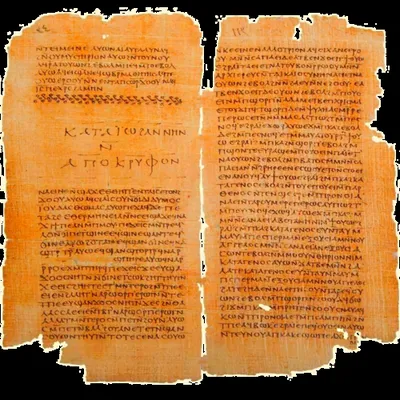
Hugo Lundhaug
The Nag Hammadi library is a collection of early Christian and Gnostic texts discovered in Egypt in 1945, comprising 52 mostly Gnostic treatises.
Discovered near Nag Hammadi in Upper Egypt in 1945, the Nag Hammadi library consists of twelve papyrus codices, plus fragments from a thirteenth, containing early Christian and Gnostic writings. These texts, buried in a jar and found by a local farmer, include 52 mostly Gnostic treatises, alongside works from the Corpus Hermeticum and a version of Plato's Republic. Scholars, including James Robinson, have hypothesized that the codices may have belonged to a nearby Pachomian monastery and were hidden after Saint Athanasius condemned non-canonical texts in 367 AD. Hugo Lundhaug and colleagues have further explored this hypothesis. The manuscripts themselves are dated from the 3rd and 4th centuries, written in Coptic, with the Gospel of Thomas being the most well-known text, for which the library contains the only complete version.
The discovery and subsequent scholarly attention involved complex narratives, including the farmer Muhammad al-Samman's account of finding the texts amidst a blood feud and superstitions. Some scholars suggest the more dramatic elements might have been a cover story, potentially related to grave robbing or a funerary deposit, while others propose they were privately commissioned prestige items. The texts were eventually gathered at the Coptic Museum in Cairo. A significant portion, known as the Jung Codex, was initially acquired by the Carl Gustav Jung Institute before also being transferred to Cairo. The translation and publication of these texts were a collaborative international effort, culminating in widely accessible editions by the late 20th century.
Discovery and Provenance
The discovery of the Nag Hammadi library occurred in late 1945 near Nag Hammadi in Upper Egypt, when a local farmer unearthed a sealed jar containing twelve leather-bound papyrus codices and a thirteenth tractate. The texts were written in Coptic and date from the 3rd and 4th centuries. Scholars have debated the circumstances of their burial; one prominent theory, expanded upon by Hugo Lundhaug and colleagues, suggests they belonged to a Pachomian monastery and were hidden following Saint Athanasius's condemnation of non-canonical books in 367 AD. However, alternative explanations range from grave robbing to the books being privately commissioned funerary prestige items. The farmer's account of the discovery is complex and includes elements that have led to skepticism among some researchers. After their discovery, the manuscripts were gradually collected, with many ending up at the Coptic Museum in Cairo.
Contents and Scholarly Significance
The collection comprises 52 treatises, predominantly Gnostic, but also includes three works from the Corpus Hermeticum and a partial adaptation of Plato's Republic. The Gospel of Thomas, the only complete text of which is found in this library, is among the most recognized works. While most interpreters date the Gospel of Thomas to the 2nd century, it is believed to be based on earlier sources. The scholarly consensus regarding the classification of all texts as Gnostic is not universal, with some arguing that certain Gospels, like Thomas, Philip, and Truth, do not fit the typical definition of Gnosticism due to their affirmation of incarnate life. The publication of these texts, facilitated by international collaboration, made a vast body of early Christian and Gnostic thought accessible to the public.
Publication and Dissemination
The process of translating and publishing the Nag Hammadi texts was a lengthy undertaking, especially after the 1952 Egyptian revolution. A pivotal moment was the 1966 Messina Congress, which spurred the formation of an international editorial team led by James M. Robinson. This led to the publication of a facsimile edition between 1972 and 1977, making the texts available for study. Robinson's English translation, The Nag Hammadi Library in English, was first published in 1977, with subsequent revised editions appearing throughout the following decades. Other significant English translations include Bentley Layton's The Gnostic Scriptures (1987). These publications marked the gradual dispersal of these previously obscure Gnostic texts into wider global circulation.
Key Ideas
- The Nag Hammadi library contains early Christian and Gnostic texts.
- The Pachomian hypothesis suggests the library belonged to a monastery and was hidden due to persecution.
- The Gospel of Thomas is a key text from the collection, with the only complete version found here.
- Scholarly debate exists regarding the classification of all texts within the library as strictly Gnostic.
Books by Hugo Lundhaug
2 free public domain books · Read online or download