Howard Batie
Al-Aqsa Mosque is a significant Islamic religious complex in Jerusalem, built and rebuilt over centuries by various caliphates and dynasties.
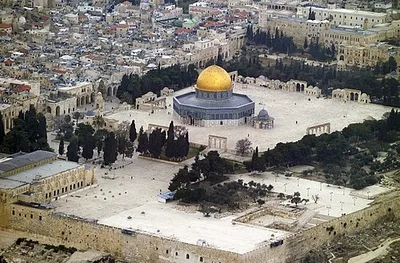
Al-Aqsa, also known as the Al-Aqṣā Mosque compound or Haram al-Sharif, is a collection of Islamic religious structures situated on the Temple Mount in Jerusalem's Old City. This site is considered the third holiest in Islam and includes the Dome of the Rock, numerous mosques, prayer halls, madrasas, and other religious buildings. The main congregational mosque within the compound is variously called Al-Aqsa Mosque, Qibli Mosque, or al-Jāmiʿ al-Aqṣā. The wider area is sometimes referred to as the Al-Aqsa Mosque compound to distinguish it from the main mosque building.
Construction of a prayer house on the site began during the Rashidun or Umayyad caliphates. The current mosque structure was established by the Umayyad caliph Abd al-Malik or his successor al-Walid I. It has undergone multiple destructions by earthquakes and subsequent reconstructions and expansions by rulers such as the Abbasids, Fatimids, Crusaders, Ayyubids, Mamluks, and Ottomans. The site holds immense geopolitical and religious significance, being central to Judaism, Christianity, and Islam, and has been a focal point in the Israeli-Palestinian conflict. The mosque has remained under the independent administration of the Jerusalem Waqf since the beginning of the Israeli occupation.
Historical Development and Reconstruction
The origins of the Al-Aqsa Mosque are traced back to the early Islamic period, with a small prayer house erected during the rule of Caliph Umar or Caliph Mu'awiya I. The present congregational mosque was initiated by the Umayyad caliph Abd al-Malik or his son al-Walid I, positioned on the same axis as the Dome of the Rock. This structure was later destroyed by an earthquake in 746 and subsequently rebuilt in 758 by the Abbasid caliph al-Mansur. Further expansions occurred in 780 under Caliph al-Mahdi. Another significant earthquake in 1033 led to its destruction, after which the Fatimid caliph al-Zahir rebuilt it, reducing its size to seven aisles but enhancing its interior with an elaborate central archway featuring vegetal mosaics. The current architectural outline largely dates back to this 11th-century reconstruction.
Dynastic Additions and Transformations
Throughout its history, ruling Islamic dynasties consistently added to and renovated the mosque and its surrounding complex. These efforts included modifications to its dome, façade, minarets, and interior elements like the minbar. Following its capture by the Crusaders in 1099, the mosque was repurposed as a palace and served as the headquarters for the Knights Templar. After Saladin reconquered the area in 1187, its function as a mosque was reinstated. Subsequent centuries saw further renovations, repairs, and expansions undertaken by the Ayyubids, Mamluks, and Ottomans. More recently, the Supreme Muslim Council of British Palestine and Jordanian authorities also contributed to its upkeep and development.
Terminology and Significance
The English term "Al-Aqsa Mosque" can refer to both al-Masjid al-Aqṣā, traditionally encompassing the entire Temple Mount compound, and Jāmiʿ al-Aqṣā, specifically denoting the congregational mosque building. Early Islamic writers and later Orientalists noted that the Quranic reference to "the farthest mosque" likely applied to the entire esplanade, known also as the Temple Mount or Haram al-Sharif, as the specific structures did not exist at the time of the Quran's writing. The wider compound became popularly known as Haram al-Sharif, meaning "Noble Sanctuary," elevating its status. In recent times, the name Al-Aqsa Mosque has gained favor among local Palestinians over Haram al-Sharif. The site's location atop the Temple Mount, historically significant for Judaism, Christianity, and Islam, imbues it with profound geopolitical importance and makes it a central point of contention in the Israeli-Palestinian conflict.
Key Ideas
- Distinction between Al-Aqsa Mosque (building) and Al-Aqsa compound (esplanade/Haram al-Sharif).
- Historical layering of construction and reconstruction by various Islamic dynasties.
- Geopolitical and religious significance of the site as a multi-faith holy location and conflict flashpoint.
Books by Howard Batie
2 free public domain books · Read online or download