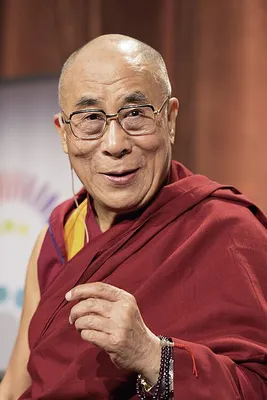
His Holiness Tenzin Gyatso the XIV Dalai Lama, Jeffrey Hopkins
The 14th Dalai Lama, Tenzin Gyatso, is the spiritual leader of Tibetan Buddhism, recognized as a Bodhisattva and living in exile.
His Holiness Tenzin Gyatso, the 14th Dalai Lama, is the preeminent spiritual leader of Tibetan Buddhism. Born Lhamo Thondup in 1935 in Amdo, Tibet, he was identified as the reincarnation of the 13th Dalai Lama and formally recognized in 1939. He assumed temporal leadership of Tibet in 1950 but fled to India in 1959 following the Chinese annexation of Tibet. He subsequently established a government-in-exile in Dharamsala, India, advocating for Tibetan autonomy and cultural preservation through a 'Middle Way Approach' with China. He retired from political leadership in 2011, allowing for a democratically elected Central Tibetan Administration.
The Dalai Lama is revered as an emanation of Avalokiteśvara, the Bodhisattva of Compassion. Throughout his life, he has traveled extensively, sharing teachings on Mahayana and Vajrayana Buddhism, including Kalachakra initiations. His engagements span diverse fields such as science, interfaith dialogue, environmentalism, and human rights. Awarded the Nobel Peace Prize in 1989, he is recognized globally for his commitment to peace, nonviolence, and the promotion of compassion.
Recognition and Early Life
Born Lhamo Thondup in 1935 to a farming family in Taktser, Amdo, the individual who would become the 14th Dalai Lama was identified as the reincarnation of the 13th Dalai Lama in 1937. The selection process involved omens, visions, and specific tests to confirm his identity. Notably, a Golden Urn selection process was waived, with approval from the Nationalist government of China. His formal enthronement occurred in Lhasa in 1940. The family, including his siblings, had several members recognized as reincarnated lamas, a phenomenon sometimes subject to regulation by governing bodies of the time.
Spiritual and Temporal Leadership
As the highest spiritual leader of Tibetan Buddhism and the head of the Gelug school, the Dalai Lama is believed to be a living Bodhisattva, an emanation of Avalokiteśvara. He served as Tibet's spiritual and temporal leader until his exile in 1959. Following the Chinese annexation of Tibet, he established the Tibetan government-in-exile in India, which later moved to Dharamshala. In 2011, he transitioned temporal leadership to a democratically elected body, the Central Tibetan Administration, while remaining the spiritual head. He is known by various honorific titles, including Gyalwa Rinpoche and Kundun.
Advocacy and Global Engagement
The Dalai Lama has dedicated much of his life to advocating for the welfare of Tibetans and the preservation of their culture and religion. He champions a 'Middle Way Approach' aimed at peacefully resolving the status of Tibet through dialogue with China, seeking a mutually beneficial arrangement where Tibet can maintain its identity while remaining part of China. He has also been a prominent global figure, traveling extensively to give Buddhist teachings and engaging in dialogues on science, ethics, and interfaith understanding. His efforts in promoting peace and compassion have earned him international recognition, including the Nobel Peace Prize in 1989.
Key Ideas
- Reincarnation as a Bodhisattva, specifically an emanation of Avalokiteśvara (Bodhisattva of Compassion).
- The 'Middle Way Approach' for resolving the issue of Tibet, seeking a middle ground for cultural preservation and Chinese sovereignty.
- Advocacy for peace, nonviolence, interfaith dialogue, and universal responsibility.
Books by His Holiness Tenzin Gyatso the XIV Dalai Lama, Jeffrey Hopkins
3 free public domain books · Read online or download