Hildegard von Bingen, Nathaniel M. Campbell, Nathaniel Campbell
Hildegard of Bingen was a German abbess, polymath, mystic, and composer known for her visions, writings, and music.
Hildegard of Bingen, a German Benedictine abbess and polymath from the High Middle Ages, was a prominent writer, composer, philosopher, mystic, and visionary. Active in the Catholic Church, she is recognized as one of the most significant composers of sacred monophony and is highly recorded in modern history. Scholars have considered her a founder of scientific natural history in Germany.
Hildegard founded monasteries at Rupertsberg and Eibingen. Her extensive writings covered theology, botany, and medicine, alongside letters, hymns, and liturgical music. She is notable for composing both the music and lyrics for her chants, more of which survive than from any other medieval composer. Her work "Ordo Virtutum" is an early example of liturgical drama. She also created an artificial language called Lingua Ignota. Though her formal canonization process was complex, she has been venerated as a saint for centuries and was officially recognized as a Doctor of the Church by Pope Benedict XVI in 2012.
Visions and Mystical Experience
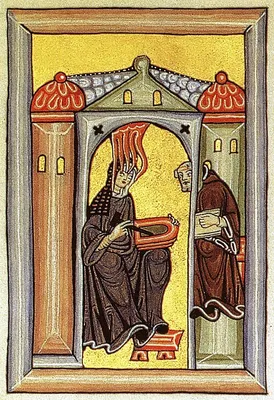
Hildegard reported experiencing visions from a very young age, describing them as seeing "The Shade of the Living Light" in her soul. She perceived these visions as a divine gift, seeing all things in the light of God through her five senses, but experienced them while fully awake, not in ecstasy. These visions were not spatial but were described as a light brighter than the sun, where writings, sermons, virtues, and actions took form. Initially hesitant to share these experiences, she confided in her tutor Jutta and later her scribe Volmar. In 1141, a divine instruction to "write down that which you see and hear" led to her physical illness until she began recording her visions, particularly in her work "Scivias."
Monastic Leadership and Founding
Elected magistra (mother superior) of her community at Disibodenberg in 1136, Hildegard later sought greater autonomy for her nuns. Despite initial resistance from Abbot Kuno, she was eventually permitted to found the monastery of Rupertsberg in 1150, moving with around 20 nuns. She later established a second monastery at Eibingen in 1165. During her leadership, a dispute arose with the clergy of Mainz regarding the burial of an excommunicated man on sacred ground, which Hildegard opposed, asserting the man's reconciliation with the Church prior to his death.
Literary and Musical Contributions
Hildegard's prolific output includes theological, botanical, and medicinal works, as well as numerous letters, hymns, and antiphons for the liturgy. She is distinguished as one of the few medieval composers who wrote both the text and music for her compositions. Her collection of surviving chants is more extensive than that of any other composer from the Middle Ages. Her allegorical musical drama, "Ordo Virtutum," is considered an early example of liturgical drama and potentially the oldest surviving morality play. She is also credited with inventing an artificial language known as Lingua Ignota.
Key Ideas
- Visions perceived as divine revelation experienced while awake
- Holistic approach to medicine and natural history
- Creation of sacred music and liturgical drama
- Development of a constructed language (Lingua Ignota)
Notable Quotes
“From my early childhood, before my bones, nerves, and veins were fully strengthened, I have always seen this vision in my soul, even to the present time when I am more than seventy years old. In this vision, my soul, as God would have it, rises up high into the vault of heaven and into the changing sky and spreads itself out among different peoples, although they are far away from me in distant lands and places. And because I see them this way in my soul, I observe them in accord with the shifting of clouds and other created things. I do not hear them with my outward ears, nor do I perceive them by the thoughts of my own heart or by any combination of my five senses, but in my soul alone, while my outward eyes are open. So I have never fallen prey to ecstasy in the visions, but I see them wide awake, day and night. And I am constantly fettered by sickness, and often in the grip of pain so intense that it threatens to kill me, but God has sustained me until now. The light which I see thus is not spatial, but it is far, far brighter than a cloud which carries the sun. I can measure neither height, nor length, nor breadth in it; and I call it "the reflection of the living Light." And as the sun, the moon, and the stars appear in water, so writings, sermons, virtues, and certain human actions take form for me and gleam.”
“But I, though I saw and heard these things, refused to write for a long time through doubt and bad opinion and the diversity of human words, not with stubbornness but in the exercise of humility, until, laid low by the scourge of God, I fell upon a bed of sickness; then, compelled at last by many illnesses, and by the witness of a certain noble maiden of good conduct [the nun Richardis von Stade] and of that man whom I had secretly sought and found, as mentioned above, I set my hand to the writing. While I was doing it, I sensed, as I mentioned before, the deep profundity of scriptural exposition; and, raising myself from illness by the strength I received, I brought this work to a close – though just barely – in ten years. [...] And I spoke and wrote these things not by the invention of my heart or that of any other person, but as by the secret mysteries of God I heard and received them in the heavenly place”
Books by Hildegard von Bingen, Nathaniel M. Campbell, Nathaniel Campbell
2 free public domain books · Read online or download