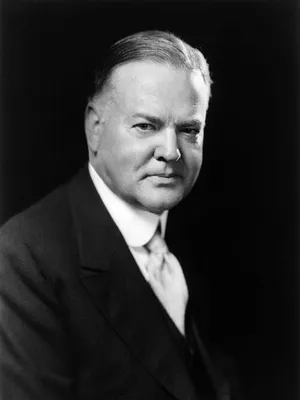
Herbert Whyte
Herbert Hoover was a US President, engineer, and humanitarian known for his extensive relief work before entering politics.
Herbert Clark Hoover served as the 31st President of the United States from 1929 to 1933. Prior to his presidency, Hoover established a career as a successful mining engineer and businessman, working internationally in countries like Australia and China. His early life was marked by hardship, including the early deaths of both parents, leading to him being orphaned and raised by relatives. He pursued higher education at the newly established Stanford University, graduating in 1895.
Hoover's public service career began with extensive humanitarian efforts. He led significant international relief organizations, including the Commission for Relief in Belgium and the American Relief Administration, providing aid to those affected by World War I and its aftermath. He also directed the U.S. Food Administration. These roles earned him considerable public recognition. He later served as the U.S. Secretary of Commerce from 1921 to 1928, playing an active role in developing areas like air travel and radio, and managing federal responses to disasters such as the Great Mississippi Flood of 1927. His presidency was largely defined by the onset of the Great Depression, with his administration's response being widely criticized.
Early Life and Education
Born in West Branch, Iowa, in 1874 to Quaker parents, Herbert Hoover experienced significant personal loss at a young age, with both his father dying in 1880 and his mother in 1884, leaving him and his siblings orphaned. He lived with relatives in Oregon, where he was influenced by a strong work ethic. Although he did not complete high school, he pursued vocational training. Hoover was part of the initial class at Stanford University, entering in 1891. He studied geology and was an active participant in campus life, co-founding a student cooperative boarding house. Despite being a mediocre student, he engaged in various jobs and extracurricular activities, and his summer internships in economic geology solidified his interest in pursuing a career in mining.
Engineering and International Business
Following his graduation from Stanford in 1895, Hoover began his career in the mining industry, initially facing job scarcity due to economic downturns. He eventually secured a position with a London-based mining firm, Bewick, Moreing & Co., which led him to work in Western Australia. There, he managed gold mines and played a key role in the success of operations like the Sons of Gwalia mine. He was known for his extensive travel across the Australian Outback and for implementing cost-saving measures, including the use of immigrant labor, and held views against minimum wage and workers' compensation. His success led to a promotion, and he was later offered a significant role in China, where he developed gold mines and became involved with the Chinese Engineering and Mining Company. His time in China coincided with the Boxer Rebellion, which trapped him and other foreigners.
Humanitarian Efforts and Public Service
Hoover's career transitioned significantly towards public service, particularly through extensive humanitarian work. During World War I, he organized and led the Commission for Relief in Belgium, an international effort that provided food to occupied Belgium. When the United States entered the war, President Woodrow Wilson appointed him to head the U.S. Food Administration, earning him the nickname "food dictator." After the war, he directed the American Relief Administration, which was responsible for delivering food aid to millions in Central and Eastern Europe, notably in Russia. He also established the Commission for Polish Relief. These widespread relief operations garnered him considerable public acclaim and support.
Secretary of Commerce and Presidency
Before becoming president, Hoover served as the United States Secretary of Commerce from 1921 to 1928 under Presidents Warren G. Harding and Calvin Coolidge. He was a notably active and influential cabinet member, sometimes referred to as "Secretary of Commerce and Under-Secretary of all other departments," contributing to the development of air travel and radio. He also led the federal response to the Great Mississippi Flood of 1927. In 1928, he won the Republican nomination and was elected president in a landslide victory. However, his presidency, beginning in 1929, was immediately overshadowed by the stock market crash and the subsequent Great Depression, a crisis his administration's policies were widely perceived as inadequately addressing.
Books by Herbert Whyte
2 free public domain books · Read online or download