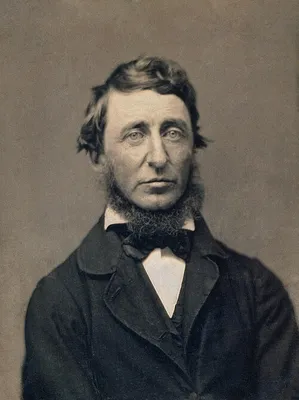
Henry David Thoreau
Henry David Thoreau was a pioneering American naturalist, essayist, and philosopher, best known for 'Walden' and 'Civil Disobedience'.
Henry David Thoreau, born David Henry Thoreau in 1817, was an American naturalist, essayist, poet, and philosopher deeply aligned with the Transcendentalist movement. He is most recognized for his seminal work 'Walden,' a profound reflection on living simply amidst nature, and his influential essay 'Civil Disobedience,' which advocated for principled opposition to unjust governmental authority. Thoreau's extensive writings, encompassing over 20 volumes of essays, journals, poetry, and natural history observations, laid groundwork for modern environmentalism by anticipating ecological and environmental history concepts.
His literary approach intricately combined keen natural observation, personal experience, sharp rhetoric, symbolic depth, and historical knowledge, all infused with a poetic sensibility and philosophical rigor. Thoreau was also a staunch abolitionist, actively speaking against the Fugitive Slave Act and supporting figures like John Brown. His philosophy of civil disobedience profoundly impacted later leaders such as Mahatma Gandhi and Martin Luther King Jr. While sometimes labeled an anarchist, he might be more accurately described as a precursor to anarchist thought.
Transcendentalist Philosophy and Nature
As a leading Transcendentalist, Thoreau embraced a philosophy that posited a spiritual reality transcending the physical world, accessible through individual intuition rather than strict dogma. This perspective viewed nature as a manifestation of inner spirit, reflecting a deep connection between the observable world and human consciousness. His writings frequently explored this relationship, examining the human condition through the lens of the natural environment. Thoreau's keen observation of nature was not merely descriptive but served as a foundation for his philosophical inquiries, intertwining personal experience with symbolic meanings and historical context. He advocated for a life stripped of excess and illusion, focusing instead on essential needs and a direct experience of existence.
Writings and Contributions to Environmentalism
Thoreau's literary output is substantial, comprising numerous essays, poems, and extensive journals. His meticulous observations of natural history and his philosophical reflections are considered foundational to contemporary fields like ecology and environmental history. He anticipated many of the methods and discoveries that would later define these disciplines, contributing significantly to the roots of modern environmentalism. His writing style is characterized by a unique blend of detailed natural analysis, personal narrative, persuasive argumentation, and symbolic interpretation, all delivered with poetic grace and philosophical depth. He also delved into themes of human resilience against adversity and decay, advocating for a return to fundamental living.
Civil Disobedience and Social Activism
A passionate abolitionist throughout his life, Thoreau actively campaigned against slavery, delivering lectures that denounced the Fugitive Slave Law and voiced support for abolitionist leaders. His most enduring contribution to political thought is the essay 'Civil Disobedience,' which argued for the moral imperative of citizens to resist unjust laws. This principle of nonviolent resistance to governmental overreach had a far-reaching impact, influencing prominent figures like Leo Tolstoy, Mahatma Gandhi, and Martin Luther King Jr. While his views on government and individual liberty have led some to classify him retrospectively as an anarchist, he is perhaps more accurately understood as an early proponent of such ideas.
Key Ideas
- Simple living in natural surroundings
- Citizen disobedience against an unjust state
- Nature as outward sign of inward spirit
- Abandoning waste and illusion for essential needs
- Anticipation of ecological and environmental history methods
Notable Quotes
“What are you doing now? Do you keep a journal? So I make my first entry to-day.”
“I went to the woods because I wished to live deliberately, to front only the essential facts of life, and see if I could not learn what it had to teach, and not, when I came to die, discover that I had not lived. I did not wish to live what was not life, living is so dear; nor did I wish to practice resignation, unless it was quite necessary. I wanted to live deep and suck out all the marrow of life, to live so sturdily and Spartan-like as to put to rout all that was not life, to cut a broad swath and shave close, to drive life into a corner, and reduce it to its lowest terms, and, if it proved to be mean, why then to get the whole and genuine meanness of it, and publish its meanness to the world; or if it were sublime, to know it by experience, and be able to give a true account of it in my next excursion.”
Books by Henry David Thoreau
2 free public domain books · Read online or download