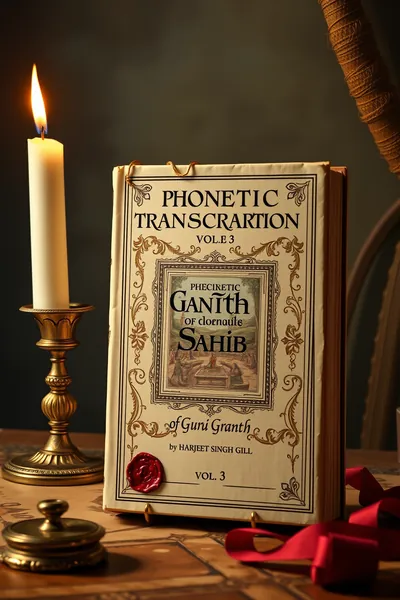
✍️ Author Biography
Harjeet Singh Gill
🌍 British
📚 3 free books
The Guru Granth Sahib is Sikhism's central scripture, containing hymns from diverse mystics and saints, including Sikh gurus.
The Guru Granth Sahib serves as the foundational religious text of Sikhism, regarded by adherents as the ultimate spiritual authority. This scripture comprises 1430 pages, featuring 5,894 devotional hymns. Notably, it incorporates writings from a wide array of 36 mystic saints and scholars, encompassing Sikh gurus, Hindu and Muslim mystics (Bhagats), bards (Bhatts), and devoted Sikhs (Gursikhs). Its inclusivity is remarkable for a religious scripture, as it contains contributions from individuals of various religious backgrounds, including Hindus and Muslims, and from diverse social strata, such as those from lower castes. The text also includes the teachings of the Sikh Gurus themselves, forming the core of Sikh philosophy.
Scholarly analysis categorizes the authors into four main groups: Sikh Gurus, Bhagats, Bhatts, and Gursikhs. While the hymns of six Sikh Gurus are definitively included, some scholars suggest the inclusion of compositions from Guru Har Rai and Guru Gobind Singh. The Bhagats were holy individuals from different traditions whose devotional poetry, known as bani, is part of the scripture, reflecting a pre-existing belief in one God that influenced Kabir. The Bhatts were Hindu Brahmin bards who became followers of Guru Nanak. The Gursikhs represent devoted Sikhs whose works are also present. The text's compilation involved careful consideration, with some potential contributors being excluded if their works did not align with Sikh tenets.
Authorship and Categorization
The central religious text of Sikhism, the Guru Granth Sahib, is a compilation of hymns and teachings from various spiritual figures. These authors are broadly categorized into four groups: Sikh Gurus, Bhagats, Bhatts, and Gursikhs. The Sikh Gurus' philosophical teachings, known as Shabad Guru, are central to Sikh belief. While the writings of six Sikh Gurus are widely accepted as being included in the scripture, there is scholarly debate regarding the inclusion of compositions from Guru Har Rai and Guru Gobind Singh. The Bhagats were holy men from diverse backgrounds, including Hindu and Muslim Sufi traditions, whose devotional writings are incorporated under the title Bani Bhagtaan Ki. The Bhatts were Hindu Saraswat Brahmins who followed Guru Nanak and served as bards, contributing their verses. Finally, the Gursikhs represent devoted Sikhs whose contributions are also part of this sacred text.
Mystical and Devotional Contributions
The Guru Granth Sahib is distinguished by its inclusion of hymns from mystics and saints of various traditions, reflecting a broad spiritual philosophy. The Bhagats, meaning devotees, contributed their compositions, which often stemmed from a deep reverence for a singular divine entity, a concept that predated Kabir's selection of their works. These individuals, some of whom were Muslim Sufis, brought a rich devotional and mystical dimension to the scripture. The Bhatts, as bards, added poetic and devotional verses, often inspired by their adherence to Guru Nanak's teachings. This diverse authorship underscores the scripture's emphasis on devotion (Bhakti) and love for the divine, transcending sectarian boundaries and social hierarchies.
Inclusivity and Textual Integrity
A significant aspect of the Guru Granth Sahib is its remarkable inclusivity, featuring writings from individuals of varied religious backgrounds, including Hindus and Muslims, and from diverse social standings, even those considered untouchable. This broad inclusion highlights a philosophical approach that values spiritual insight regardless of origin. The compilation process itself involved careful discernment; Sikh tradition recounts instances where Guru Arjan, the principal compiler, considered works from various individuals but ultimately rejected those that did not align with Sikh tenets. For example, the works of Pilu, Kahna Bhagat, Chajju Bhagat, and Shah Husain were deemed unsuitable due to their perceived pessimistic outlook or promotion of escapism, demonstrating a commitment to maintaining the scripture's spiritual and philosophical coherence.
Key Ideas
- Shabad Guru: The divine word as the ultimate spiritual authority in Sikhism.
- Bhakti: Devotion and love for the divine as a central spiritual practice.
- Inclusivity in scripture: Acceptance of contributions from diverse religious and social backgrounds.
- Discernment of spiritual teachings: Careful selection of texts to ensure alignment with core tenets.