✍️ Author Biography
Hajo Banzhaf
📅 1947 – 2009
🌍 German
📚 5 free books
⭐ Known for: The Book of Thoth: A Short Essay on the Ta...
Aleister Crowley's 'The Book of Thoth' explores the symbolism and use of the Thoth Tarot deck.
Published in 1944, 'The Book of Thoth: A Short Essay on the Tarot of the Egyptians' is a significant work by the occultist Aleister Crowley. It serves as a detailed examination of the Thoth Tarot deck, which Crowley conceived and which was illustrated by Lady Frieda Harris between 1938 and 1943. The deck and the accompanying book integrate various esoteric traditions, including ceremonial magic, astrology, alchemy, Egyptian mythology (specifically the Book of Thoth), and Crowley's own religious philosophy of Thelema. The publication was initially a limited edition of 200 signed copies, bound in Moroccan leather and printed on high-quality paper, selling out quickly.
The book itself is structured into four main parts: The Theory of the Tarot, The Atu (Major Arcana), The Court Cards, and The Minor Cards. These sections delve into the theoretical underpinnings, the symbolic meaning of the trump cards, and the intricacies of the court and minor cards. Appendices further explore the use of Tarot in divination and present mathematical and philosophical correspondences, such as the Key Scale of the Tree of Life and its relation to the I Ching trigrams. The work is noted for its profound symbolic depth and its connection to Hermetic Qabalah.
Symbolism and Esoteric Integration
'The Book of Thoth' is a comprehensive exploration of the Thoth Tarot deck, a creation of Aleister Crowley and Lady Frieda Harris. The deck's design and the book's content are deeply rooted in a synthesis of diverse esoteric systems. It draws heavily from ceremonial magic, the principles of astrology, the transformative processes of alchemy, and ancient Egyptian lore, particularly the concept of Thoth. Furthermore, it is intrinsically linked to Thelema, the spiritual philosophy founded by Crowley. The integration of Hermetic Qabalah is central, providing a framework for understanding the complex symbolic language employed throughout the deck and text. This multi-layered approach aims to reveal a profound system of divination and spiritual insight.
Structure and Content
The book is systematically organized to guide the reader through the Thoth Tarot system. It is divided into four principal sections: 'The Theory of the Tarot,' which lays the groundwork for understanding the deck's philosophy; 'The Atu (Keys or Trumps),' detailing the major arcana; 'The Court Cards,' focusing on the royalty of the deck; and 'The Small Cards,' covering the numbered cards. Each part is further subdivided to provide in-depth analysis. The appendices offer additional specialized information, including a guide to Tarot divination and a unique presentation of the Key Scale of the Tree of Life, which incorporates mathematical concepts like conic sections and relates them to the trigrams of the I Ching, illustrating the book's commitment to a cross-disciplinary esoteric framework.
Publication and Legacy
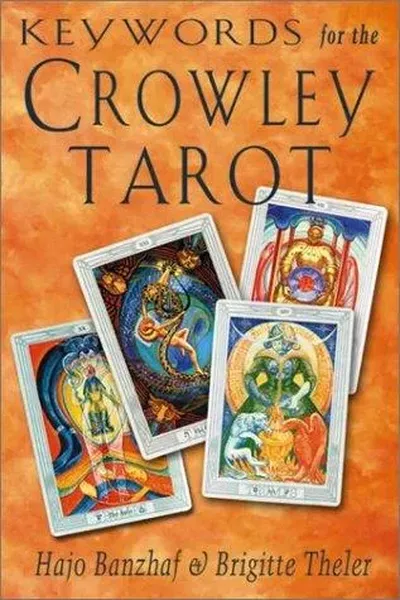
First appearing as 'The Equinox, volume III, number 5' on the vernal equinox of 1944, 'The Book of Thoth' was initially released in a limited edition of 200 numbered and signed copies. This exclusive printing, bound in Moroccan leather on pre-war paper, was a commercial success, with Crowley selling a significant value in a short period. The book has since seen wider distribution, with notable editions published in 1969 by Samuel Weiser. Its influence extends to modern Tarot scholarship, with authors like Hajo Banzhaf and Brigitte Theler producing further works that explore and explain the complexities of the Crowley Tarot, underscoring its enduring significance in the study of occult and esoteric traditions.
Key Ideas
- The Thoth Tarot deck as a synthesis of esoteric systems.
- Integration of ceremonial magic, astrology, alchemy, Egyptian mythology, and Thelema.
- Hermetic Qabalah as a foundational structure for Tarot symbolism.
- Detailed exploration of Tarot theory, major arcana, court cards, and minor cards.
- Application of Tarot in divination and cross-disciplinary esoteric correspondences.