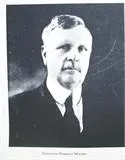
Gustavus Hindman Miller
Gustavus Hindman Miller was a Tennessee businessman and author, known for his family history and literary works.
Gustavus Hindman Miller (1857–1929) was a prominent figure in Chattanooga, Tennessee, involved in business, finance, and writing. Born in frontier Texas, his early life was marked by the loss of his father and grandmother, and he was raised by his maternal grandfather amidst challenging post-Civil War conditions. Miller received his education in common schools in Texas.
Miller's professional life began in mercantile pursuits. He moved to Tennessee and established several general merchandise stores. He later co-founded the successful Miller Brothers Company department store in Chattanooga with his brother, which became a significant retail establishment in the South. Beyond retail, Miller held leadership roles in hosiery mills and financial institutions, demonstrating a broad business acumen. He also authored several books, including family histories and other literary works, and was involved in civic life.
Early Life and Education
Born in Texas in 1857, Gustavus Hindman Miller's early years were shaped by pioneer life and significant family losses. His father died in a Confederate army camp when Miller was young, and he also lost his grandmother around the same age. He was raised by his maternal grandfather, James Lowery McGee, in a large household that faced hardship, particularly after the Civil War. Miller received his education in the common schools of Coryell County, Texas. His childhood recollections, shared in his book 'The Millers of Millersburg,' paint a picture of a simple, adventurous youth on the Texas frontier, marked by a connection to nature and a strong sense of honesty instilled by his upbringing.
Business and Financial Ventures
Gustavus Hindman Miller transitioned from his early Texas roots to a significant career in business, primarily in Tennessee. Alongside his brother, Frank Lubbock Miller, he established the Miller Brothers Company department store in Chattanooga in 1889. This venture grew from a small store to a large, successful retail operation, noted for its extensive merchandise and architectural features like a prominent skylight. Miller's business interests extended beyond retail; he was a founder and president of Buster Brown's Hosiery Mills and the United Hosiery Mills Corporation. Furthermore, he held executive positions in banking, including Vice-President and Director of the Hamilton National Bank, and was involved in investment companies managing his real estate holdings.
Literary Contributions
Beyond his extensive business activities, Gustavus Hindman Miller was also a prolific author. He dedicated his evenings to literary pursuits, producing a range of works that garnered attention. Among his notable publications are 'Lucy Dalton' (1883), 'Is Marriage a Failure' (1895), 'What's in a Dream?' (1901), and 'Thysparia the Mysterious' (1909). He also authored 'Tribute to His Brother' (1921) and 'The Jew' (1921). His most significant literary undertaking was 'The Millers of Millersburg' (1923), a family record compiled in conjunction with J. Bailey Nicklin, Jr., which documented the history and experiences of his family.
Notable Quotes
“It is interesting to follow the illusive tracery in memory across that hazy span of life between the ages of four and seven. My father and Grandmother McGee died when I was about four years of age. I only remember to have seen my father going to the barn or attending to the stock—a colt or calf was prominent in my affection at that age. I only remember to have seen my grandmother when cooking. She must have encouraged me, her second grandson, in loving her, by giving me such dainties as she could prepare from meager after-servings. My grandmother's death lost her children a boundless love. My memory of these two ancestors is no doubt due to an inherited love of saddle and bridle, and a more primitive instinct to look for something to eat. I do not remember having seen my father about the house, or any game he may have played with us.”
“About two years after grandmother's death, grandfather married a young widow with two children, Mrs. Hannah Miller, daughter of William Miller. Six children were born to this marriage. Owing to the second marriage of my mother, grandfather became the guardian of my brother and myself. We therefore spent much of our time in his home. When the family was rounded out, there were four sets of children; ten by his first wife, six by his second, two stepchildren, and two grandchildren. My grandfather was a man of sterling character; the trick fellow who would cheat in a trade did not appeal to him. He had contempt for many successful men because he believed them dishonest. He used to trade in a dry goods store where there were two brothers. He said one was honest, but the other was not. Time proved his insight correct.”
“Gus, I think of you more than ever as I get old. The happiest of my days were when we went to school at the old board shanty and the old rock house. ...those were great days. We never dreamed of violating the law; our minds were in a different channel. We were taught honesty if we were taught anything. We ran our own boat from the beginning, almost.”
“I want to impress upon you that this Rainey's Creek country is level prairie, fine black land, owned by Germans. Gus and I can well remember when it was the greatest country, socially, in the world. The boys and girls who were raised there have proved to be the very highest type of manhood and womanhood. No one ever heard of trouble with the old settlers, that is, between themselves. Then we visited and loved each other and lived peaceably with all mankind. We were what you folks call wild, but we were sons of adventurers who came here, to land untried. We would ride the wildest horses ever known to the world. We didn't do anybody any harm. I have seen this same polished, shrewd Gustavus Miller ride the wildest horses I ever saw. I saw him tie a red handkerchief around his head, make his horse pitch around the arbor where preaching was to be held for the benefit of the crowd. He didn't charge a cent nor do any harm!”
Books by Gustavus Hindman Miller
5 free public domain books · Read online or download