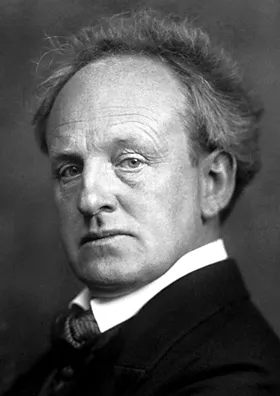
Gerhart Hauptmann
Gerhart Hauptmann was a Nobel Prize-winning German dramatist and novelist, a key figure in literary naturalism, whose work explored social issues and later philosophical themes.
Gerhart Hauptmann, born in 1862, emerged as a prominent German dramatist and novelist, significantly contributing to the literary movement of naturalism while also incorporating other stylistic elements. His early life in Silesia was marked by difficulties with schooling and health, leading him to explore various paths including agriculture and sculpture before dedicating himself to writing. He married Marie Thienemann in 1885, and they lived in Erkner due to his lung ailment. Hauptmann's literary career took off with naturalist plays like 'Before Sunrise' and 'The Weavers,' which depicted social realities and historical events. His personal life saw a separation from Marie and a subsequent marriage to Margarete Marschalk. He received significant recognition, including the Nobel Prize in Literature in 1912, though his relationship with the ruling powers was complex, sometimes facing political opposition despite his contributions. He lived until 1946, leaving a substantial literary legacy.
Early Life and Artistic Pursuits
Born in Lower Silesia in 1862, Gerhart Hauptmann experienced a challenging youth marked by difficulties in adjusting to formal education and recurring illnesses. He initially pursued agriculture on his uncle's farm but had to abandon it due to physical strain and a serious lung ailment. His artistic inclinations led him to study sculpture in Breslau, where he befriended Josef Block and briefly attended the Royal Art and Vocational School. During this period, he also explored philosophy and literary history at the University of Jena, financed by his future wife, Marie Thienemann. A trip to the Mediterranean with his brother Carl solidified his early artistic aspirations as a sculptor, though his attempts to establish himself in Rome met with little success, prompting his return to Germany and further studies in Dresden and Berlin, where his focus increasingly shifted towards the theater.
Literary Career and Naturalism
Hauptmann's marriage to Marie Thienemann in 1885 marked the beginning of his dedicated writing career. Initially residing in Erkner to manage his health, he became involved with the naturalist literary circle 'Durch' in Berlin. His novella 'Bahnwärter Thiel' (1887) and his groundbreaking play 'Before Sunrise' (1889) are considered seminal works of German literary naturalism, focusing on realistic portrayals of social conditions and psychological depth. He followed this with significant dramas such as 'The Reconciliation' (1890), 'Lonely People' (1891), and the widely acclaimed 'The Weavers' (1892), which dramatized the plight of Silesian weavers. His oeuvre also included comedies, demonstrating a versatility that extended beyond strict naturalism.
Recognition and Later Years
Throughout his life, Hauptmann garnered considerable acclaim, including multiple Austrian Franz-Grillparzer Prizes and honorary doctorates from prestigious institutions like Oxford and Leipzig. The pinnacle of his recognition came in 1912 with the Nobel Prize in Literature, awarded for his significant contributions to dramatic art. Despite this, his relationship with the political establishment was not always smooth; Kaiser Wilhelm II opposed some of his works for their perceived social or pacifist leanings. Hauptmann's later life saw him living with his second wife, Margarete Marschalk, in Agnetendorf, which he considered a spiritual sanctuary. He continued to write, producing novels like 'The Fool in Christ, Emanuel Quint' and 'Atlantis,' and engaging with emerging media like film, though some of his screenplays were never produced. He remained a significant figure in German literature, representing it abroad and receiving numerous honors, including honorary citizenships and the Goethe Prize.
Navigating Political Landscapes
Hauptmann's engagement with the political climate of his time was complex. While he initially signed the Manifesto of the Ninety-Three in support of German military actions at the start of World War I and received honors from Kaiser Wilhelm II, he later fled to Switzerland after Germany's defeat. He expressed solidarity with the new republic and was considered for high political office, though he declined such roles. During the Nazi era, Hauptmann signed a loyalty oath to the German Academy of Literature and reportedly applied for Nazi party membership, though his application was denied. He annotated his copy of 'Mein Kampf' extensively, viewing himself as an artist above politics, and his works did not incorporate Nazi ideology, though his actions and affiliations during this period remain a subject of historical discussion.
Key Ideas
- Literary Naturalism: Focus on realistic depiction of social conditions, heredity, and environment.
- Social Commentary: Exploration of the struggles and conditions of the working class and marginalized individuals.
- Psychological Realism: Deep dive into the inner lives and motivations of characters.
- Pacifism vs. Nationalism: Navigating personal beliefs against nationalistic fervor during wartime.
Books by Gerhart Hauptmann
2 free public domain books · Read online or download