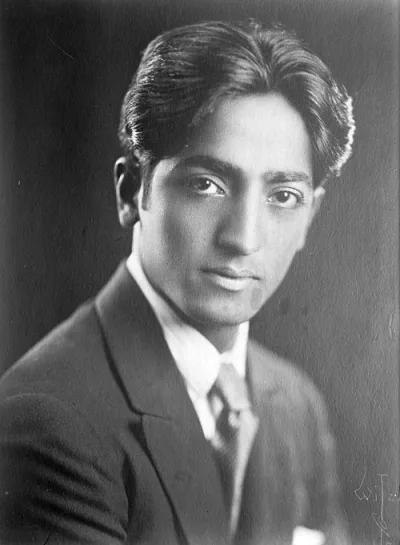
George S. Arundale
Jiddu Krishnamurti was an Indian spiritual figure raised by the Theosophical Society to be a World Teacher, who later rejected this role to advocate for individual truth.
Jiddu Krishnamurti, born in 1895 in British India, was identified by the Theosophical Society as the potential World Teacher, destined to guide humanity's spiritual evolution. Adopted and educated by prominent Theosophists, he was prepared for this role from a young age. However, in 1929, after experiencing profound mystical episodes, Krishnamurti broke away from the Theosophical movement and dissolved the organization formed around him.
He spent the remainder of his life traveling globally, speaking to audiences about his philosophy. Krishnamurti emphasized that "truth is a pathless land," urging individuals to seek truth independently, free from doctrines, gurus, or external authority, including himself. His teachings focused on a radical transformation of consciousness through passive awareness, which he considered the essence of true meditation. His work gained wider recognition in the mid-20th century, leading to the publication of several influential books.
Early Life and Theosophical Adoption
Born into a Telugu-speaking Brahmin family in Madras Presidency, Jiddu Krishnamurti's early life was marked by illness and a sensitive, introspective nature. Despite being considered intellectually slow by some, he experienced psychic events and a deep connection with nature from childhood. His father, an employee of the British colonial administration and an early Theosophist, later secured employment at the Theosophical Society's headquarters in Adyar. It was there that Krishnamurti, then a teenager, was noticed by Charles Leadbeater, a prominent Theosophist who, using his claimed clairvoyance, perceived Krishnamurti as possessing an exceptionally pure aura and destined to be the vehicle for the World Teacher, an advanced spiritual entity. The Theosophical Society, led by Annie Besant, subsequently took over his upbringing and education, preparing him for this prophesied role.
Rejection of the World Teacher Role and Independent Teachings
Following his discovery and intensive preparation by the Theosophical Society, Krishnamurti was groomed to be the channel for the World Teacher. He was educated in various subjects, including languages, and cultivated a public image of sober detachment. However, around 1922, he began experiencing intense mystical episodes that fundamentally altered his perception. This led to a profound disillusionment with the path laid out for him. In 1929, he publicly renounced the role of World Teacher, disbanded the Order of the Star in the East, and severed ties with the Theosophical Society. He asserted that truth was a "pathless land," rejecting all organized religion, spiritual disciplines, and the concept of a spiritual leader. He dedicated his life to speaking and writing, encouraging individuals to achieve inner transformation through self-awareness and direct perception, free from thought and conditioning.
Later Life and Legacy
Krishnamurti continued to travel and speak extensively throughout his life, addressing large audiences and engaging in dialogues with various individuals and groups. His message centered on the necessity of a radical transformation of human consciousness, achievable through a state of choiceless awareness, which he considered the core of true meditation. His ideas gained broader recognition in the 1950s, particularly after Aldous Huxley facilitated introductions to mainstream publishers. Several of his talks and writings were published, including "The First and Last Freedom." In his final days, he expressed a belief that a unique spiritual intelligence had passed through him and would not reappear for centuries. His legacy endures through schools established based on his educational philosophy and the continued dissemination of his extensive body of work by foundations in India, Britain, and the United States.
Key Ideas
- Truth is a pathless land: Rejection of doctrines, gurus, and external authority in the search for truth.
- Choiceless awareness: The practice of passive observation without judgment or thought as the essence of meditation and transformation.
- Radical transformation of mankind: The need for fundamental change in human consciousness and individual perception.
Notable Quotes
“truth is a pathless land”
“I would have died”
Books by George S. Arundale
2 free public domain books · Read online or download