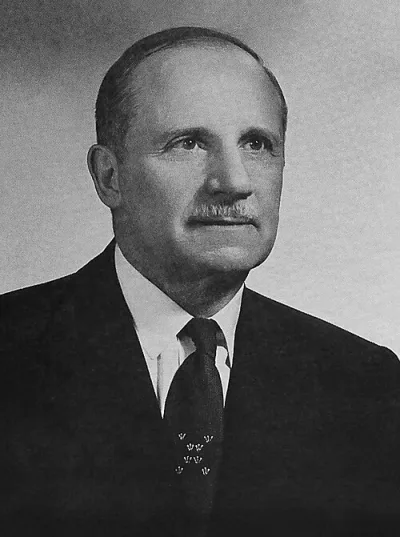
George Emmanuel Mylonas was a Greek archaeologist known for excavations at Mycenae and Eleusis, linking myth to archaeology.
George Emmanuel Mylonas was a Greek archaeologist specializing in ancient Greece and Aegean prehistory. Born in Smyrna, he received an elite education and fought in the Greco-Turkish War, experiencing significant trauma during the destruction of his hometown. After his release from captivity, Mylonas began a long association with the American School of Classical Studies at Athens, participating in significant excavations.
Mylonas pursued advanced studies in the United States, earning a second Ph.D. and teaching at universities like Johns Hopkins and the University of Chicago before settling at Washington University in St. Louis for many years. He returned to Greece later in life, becoming involved in the conservation of the Acropolis monuments. His extensive excavation work, particularly at Mycenae and Eleusis, aimed to connect archaeological findings with ancient Greek myths, including the Eleusinian Mysteries, a controversial approach in his time.
Early Life and Trauma
George Emmanuel Mylonas was born in Smyrna in 1898 to a Greek-speaking family. His early education was at elite institutions, including the Evangelical School and the International College. He enrolled at the University of Athens in 1919 and joined the Greek Army, fighting in the Greco-Turkish War. Mylonas was present during the devastating destruction of Smyrna in 1922 and was subsequently captured and imprisoned, enduring hardship and torture. He eventually secured his release in 1923 with the assistance of American contacts.
Archaeological Career and Association with ASCSA
Following his release, Mylonas returned to Athens and began working for the American School of Classical Studies at Athens (ASCSA) in 1924, initiating a lifelong connection. He served as the school's first bursar and participated in excavations at various sites, including Corinth, Nemea, and Olynthus. He earned his Ph.D. from the University of Athens in 1927. Mylonas then moved to Johns Hopkins University in the United States to study under David Moore Robinson, a prominent archaeologist he had met during excavations at Olynthus. He later taught at the University of Chicago before returning to Greece for a period of teaching and initial excavations at Eleusis.
Academic Tenure and Major Excavations
In 1931, Mylonas joined the University of Illinois and subsequently moved to Washington University in St. Louis in 1933, where he remained until 1969. During his tenure, he became a naturalized US citizen and rose to the rank of full professor. He played a significant role in the ASCSA's managing committee and co-directed excavations at Olynthus. His extensive excavation work continued at sites such as Pylos, Mycenae, and Eleusis. At Mycenae, he led excavations of Grave Circle B and the citadel, contributing significantly to understanding the site's chronology and the function of its Cult Center, which he named.
Connecting Myth and Archaeology
Mylonas's archaeological career was marked by his strong conviction that ancient Greek mythical traditions, particularly those concerning the Trojan War and the Eleusinian Mysteries, could be archaeologically verified. He applied this approach to his work at sites like Eleusis, aiming to uncover physical evidence for legendary events and rituals. While this methodology was influential in his time, it was also considered controversial and has faced skepticism from later scholars who question the direct correlation between myth and archaeological discovery. Despite controversies, his work at Mycenae was credited with organizing and publishing disparate excavation findings.
Key Ideas
- Belief that ancient Greek mythical traditions could be verified by archaeological excavation.
- Identification and naming of the Cult Center at Mycenae.
- Significant contributions to the understanding and publication of the Mycenae excavations, particularly Grave Circle B.
Books by
2 free public domain books · Read online or download