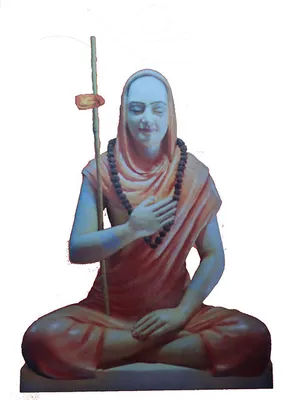
Gauḍapāda Ācārya.
Gaudapada, an early Advaita Vedanta philosopher, authored the Mandukya Karika, a foundational text on nonduality.
Gaudapada was an influential Hindu philosopher and scholar associated with the Advaita Vedanta school, likely active in the 6th or 7th century CE. While biographical details are scarce and debated, his teachings profoundly impacted later thinkers, notably Adi Shankara, whom Gaudapada considered his "highest teacher" or "teacher's teacher." His most significant contribution is the Mandukya Karika, a philosophical treatise that elaborates on the Mandukya Upanishad. This work, also known as Gaudapada Karika or Agama Shastra, is considered the earliest systematic exposition of Advaita Vedanta.
The Mandukya Karika is structured into four chapters, exploring concepts of reality, unreality, and nonduality. While the text incorporates Buddhist terminology, particularly in its fourth chapter, its core doctrine remains firmly within the Vedantic tradition. The first three chapters are particularly influential in Advaita Vedanta, with the first chapter also being recognized as scriptural by Dvaita and Vishishtadvaita schools. Gaudapada's Karika presents rational arguments to support the Advaita doctrine, examining states of consciousness, the nature of reality, and the ultimate oneness of existence.
The Mandukya Karika: A Philosophical Masterpiece
Gaudapada is primarily known for authoring or compiling the Mandukya Karika, also referred to as Gaudapada Karika or Agama Shastra. This text is a verse-by-verse commentary and expansion on the Mandukya Upanishad, one of the shortest but most profound Upanishads. The Karika is considered the earliest systematic treatise on Advaita Vedanta, presenting sophisticated arguments for the nondual nature of reality. It utilizes concepts such as dream states, the nature of space and time, and causality to illustrate its philosophical points. While its first three chapters are foundational to Advaita Vedanta, the fourth chapter shows influence from Buddhist thought, though the overall doctrine remains Vedantic. The text's first chapter is also regarded as scriptural by other Vedanta schools like Dvaita and Vishishtadvaita.
Chronology and Influence
The precise dating of Gaudapada's life is uncertain, with estimates generally placing him in the 6th or 7th century CE. This dating is often inferred from his presumed connection to Adi Shankara's lineage. Shankara himself referred to Gaudapada with great reverence, calling him a "Paramaguru" (highest teacher) or "teacher's teacher." Alternative dating methods, based on references in Buddhist literature to the Gaudapada Karikas, suggest an earlier period around 500 CE. Gaudapada's work predates Shankara and is considered a crucial precursor to the full development of Advaita Vedanta, laying the groundwork for its core philosophical tenets.
Key Concepts in the Karika
The Mandukya Karika systematically explores the Advaita Vedanta philosophy through its four chapters. Chapter One, 'Agama Prakarana,' discusses the traditional doctrine and the four states of consciousness (waking, dreaming, deep sleep, and the transcendent Turiya), linking them to the syllables of Om. Chapter Two, 'Vaitathya Prakarana,' delves into the unreality of the perceived world, arguing that both dream and waking experiences are ultimately illusory when compared to the true reality of the Self (Atman). Chapter Three, 'Advaita Prakarana,' elaborates on the principle of nonduality, using analogies like space within jars to explain how the One Self can appear as many individual souls (Jivas) without being affected. Chapter Four, 'Alatasanti Prakarana,' further explores these themes, incorporating Buddhist terminology to discuss the peace found in realizing nonduality.
Key Ideas
- Advaita Vedanta: The philosophical system asserting the ultimate oneness of reality, where the individual self (Atman) is identical to the ultimate reality (Brahman).
- Mandukya Karika: A foundational text elaborating on the Mandukya Upanishad, presenting rational arguments for Advaita principles.
- Four States of Consciousness: Analysis of waking (Vishva), dreaming (Taijasa), deep sleep (Prajna), and the transcendent state (Turiya).
- Unreality of the World: The argument that perceived duality and empirical reality are ultimately illusory (Maya).
- Nonduality (Advaita): The core principle that only Brahman exists, and all apparent multiplicity is an illusion.
Books by Gauḍapāda Ācārya.
2 free public domain books · Read online or download