Florentino Garcia Martinez, Eibert Tigchelaar
The Book of Enoch is an ancient Jewish apocalyptic text detailing the origins of demons, fallen angels, and the Genesis flood.
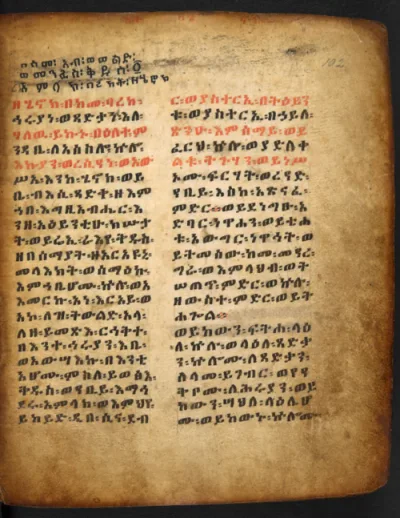
The Book of Enoch, also known as 1 Enoch, is an ancient Jewish apocalyptic religious text traditionally attributed to Enoch, Noah's great-grandfather. It offers unique accounts of the genesis of demons and the Nephilim (angel-human hybrids), explains the moral necessity of the Genesis flood, and provides a prophetic vision of the Messiah's millennial reign. While not considered canonical by most Jewish or Christian traditions, it is included in the canon of the Ethiopian Jewish community (Beta Israel) and the Ethiopian and Eritrean Orthodox Tewahedo Churches. Scholarly estimates place the composition of its older sections between 300 and 200 BCE, with the latest part possibly from around 100 BCE. It is believed to have been originally written in Aramaic or Hebrew, though no Hebrew version survives, with fragments preserved in Aramaic among the Dead Sea Scrolls. The New Testament authors were aware of its contents, with a passage from 1 Enoch cited in the Epistle of Jude. The complete text is preserved solely in the Ge'ez translation.
Structure and Content of 1 Enoch
The Book of Enoch is structured into five main parts: The Book of the Watchers, The Book of Parables (or Similitudes), The Astronomical Book (or Book of Heavenly Luminaries), The Book of Dream Visions, and The Epistle of Enoch. Most scholars believe these sections were initially independent works composed at different times, later combined and redacted into the current form of 1 Enoch. The Book of the Watchers, dating from the 4th or 3rd century BCE, describes the fall of angelic beings known as the Watchers, who fathered the Nephilim with human women. It details Enoch's celestial journeys, revelations, and visions, including the origins of evil, the corruption of humanity, and divine judgments. The text also touches upon the order of celestial bodies and the concept of divine providence.
The Fall of the Watchers and the Nephilim
A central theme in the Book of the Watchers is the transgression of the angels. Led by Samyaza, 200 angels descended to Mount Hermon, took human wives, and produced offspring called Nephilim, described as giants who consumed humanity's resources and then turned against mankind, birds, beasts, and fish, leading to widespread violence and blood-drinking. These fallen angels also imparted forbidden knowledge to humans; Azazel taught metallurgy, weaponry, cosmetics, and jewelry making, while others instructed in astrology, enchantments, and the interpretation of signs related to the cosmos and the earth. This corruption prompted divine intervention, with archangels appealing to God, leading to Uriel's warning to Noah about the impending deluge and divine commands for Raphael and Michael to bind the fallen angels and Azazel, and for Gabriel to incite the Nephilim to destroy each other.
Cosmological and Eschatological Themes
Beyond the narrative of the fallen angels, 1 Enoch contains significant cosmological and eschatological material. The Astronomical Book, for instance, details the movements and cycles of celestial bodies, emphasizing their divinely ordained order and the impossibility of deviation. This reflects a worldview where all phenomena are meticulously planned and executed according to God's eternal decree. The book also presents visions of future judgment, the fate of the wicked and the righteous, and the eventual reign of the Messiah. These sections provide a framework for understanding divine justice and the ultimate restoration of order, linking earthly corruption to heavenly judgment and eventual salvation.
Key Ideas
- Origins of demons and Nephilim
- Reasons for the Genesis flood
- Prophecy of the Messiah's reign
- Cosmological order of celestial bodies
- Divine judgment and future retribution
Notable Quotes
“Observe and see how (in the winter) all the trees seem as though they had withered and shed all their leaves, except fourteen trees, which do not lose their foliage but retain the old foliage from two to three years till the new comes.”
“And all His works go on thus from year to year for ever, and all the tasks which they accomplish for Him, and their tasks change not, but according as God hath ordained so is it done.”
“And Semjâzâ, who was their leader, said unto them: "I fear ye will not indeed agree to do this deed, and I alone shall have to pay the penalty of a great sin."”
“And they were in all two hundred; who descended in the days of Jared on the summit of Mount Hermon, and they called it Mount Hermon, because they had sworn and bound themselves by mutual imprecations upon it.”
“And they became pregnant, and they bare great giants, whose height was three hundred ells: Who consumed all the acquisitions of men. And when men could no longer sustain them, the giants turned against them and devoured mankind.”
Books by Florentino Garcia Martinez, Eibert Tigchelaar
3 free public domain books · Read online or download