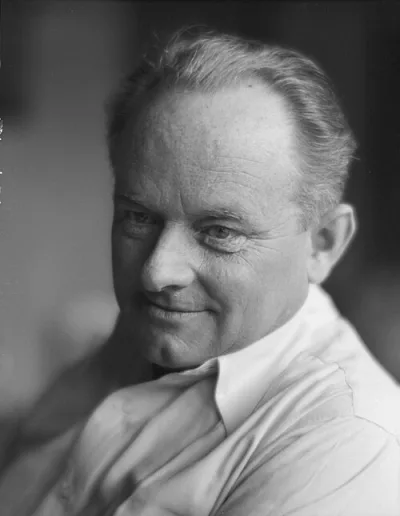
Ernest Holmes was a key figure in New Thought, founding Religious Science and authoring 'The Science of Mind'.
Ernest Shurtleff Holmes (1887–1960) was an influential American writer and teacher within the New Thought movement. He established Religious Science, a spiritual philosophy also known as "The Science of Mind." Holmes authored seminal works, including the foundational text "The Science of Mind," and founded "Science of Mind" magazine, which has been in continuous publication since 1927. His teachings, rooted in the belief that Universal Mind manifests human experience through dominant thought patterns, have profoundly impacted metaphysical students and teachers for generations. Previously, he had been an ordained minister in the Divine Science tradition. His ideas also resonated within the broader self-help movement.
Born in Maine, Holmes left home at fifteen and later supported his education in Boston, where he encountered Christian Science and the writings of Mary Baker Eddy. Moving to California, he and his brother delved into the works of prominent New Thought thinkers. Holmes began leading spiritual meetings, which led to nationwide speaking engagements. His major philosophical work, "The Science of Mind," was published in 1926, followed by the incorporation of the Institute of Religious Science. His teachings, presented in a Christian context, emphasized the power of directed thought and belief in shaping reality, drawing parallels with emerging scientific concepts of his time.
The Science of Mind Philosophy
Ernest Holmes's core teaching, known as The Science of Mind, posits that a Universal Mind or God is the origin of all existence, manifesting reality based on the collective beliefs of humanity. He taught that individuals can access and direct this Universal Mind's creative power through focused thought and certainty. Holmes believed that sustained belief in a particular outcome, whether positive or negative, would invariably bring it into manifestation. He stressed the importance of concentrating solely on good, refuting negative conditions by recognizing the limitless nature of Mind. This approach, he felt, was scientifically provable, forming a "golden thread of truth" across religions, philosophy, and emerging physics.
Founding Religious Science
Holmes's journey into establishing Religious Science began with small meetings in Los Angeles, leading to invitations to speak at the Metaphysical Library and subsequent nationwide tours. His first book, "The Creative Mind," was published in 1919. After extensive travel, he settled in Los Angeles to complete his magnum opus, "The Science of Mind," released in 1926. He then began holding Sunday lectures in increasingly larger venues, such as the Ambassador Hotel theater and the Ebell Theatre. In 1927, he formally established the Institute of Religious Science and School of Philosophy, Inc., and launched "Science of Mind" magazine. His organization evolved over the years, eventually becoming the Church of Religious Science in 1954.
Recognition and Legacy
Ernest Holmes received several honorary degrees and accolades for his contributions. Andhra University in India awarded him a Doctor of Philosophy in 1945, while the California College of Medicine and the Foundation Academic University of Spiritual Understanding in Italy bestowed upon him a Doctor of Letters. He was also recognized with the Cross of the Commander of the Grand Humanitarian Prize of Belgium in 1942 and named an honorary member of the Eugene Field Society in 1944. His influential works continue to be published, and the principles of The Science of Mind are carried on by various organizations, influencing spiritual seekers and teachers across generations.
Key Ideas
- Universal Mind as the source of all creation.
- Manifestation of reality through dominant thought and belief.
- The power of directed thought to shape personal experience.
- Emphasis on focusing on good and refuting negative conditions.
- The provability of spiritual principles through practice.
Notable Quotes
“There is a Universal Mind, Spirit, Intelligence, that is the origin of everything: It is First Cause. It is God. This Universal Life and Energy finds an outlet in and through all that is energized, and through everything that lives.”
“Experience has taught us that the subjective tendency of this intelligent Law of creative force may consciously be directed and definitively used. This is the greatest discovery of all time.”
“Never look at that which you do not wish to experience. No matter what the false condition may be, it must be refuted. The proper kind of denial is based upon the recognition that, in reality, there is no limitation, for Mind can as easily make a planet as an acorn. The Infinite knows no difference between a million dollars and a penny. It only knows that IT IS.”
“So plastic is mind, so receptive, that the slightest thought makes an impression upon it. People who think many kinds of thought must expect to receive a confused manifestation in their lives. If a gardener plants a thousand kinds of seeds, he will get a thousand kinds of plants; it is the same in mind.”
Books by
2 free public domain books · Read online or download