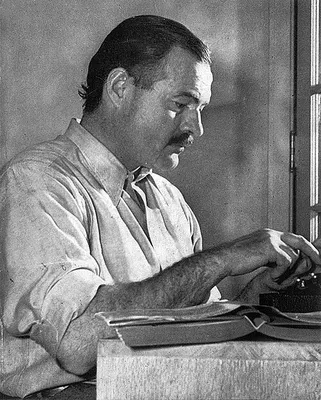
Ernest Hemingway was an American author known for his concise style, adventurous life, and classic literary works, including those inspired by war and nature.
Ernest Hemingway was an American novelist, short-story writer, and journalist celebrated for his economical prose that significantly influenced 20th-century literature. His life was marked by adventure and a distinct public persona. Hemingway's literary output includes notable novels and short story collections that have achieved classic status in American literature. He was recognized with the Nobel Prize in Literature in 1954.
Born in Oak Park, Illinois, Hemingway's early life included experiences in journalism and military service. He served as an ambulance driver on the Italian Front during World War I, where he was severely wounded. This experience, along with his later coverage of the Spanish Civil War and World War II, provided rich material for his writing. His time as an expatriate in Paris during the 1920s also shaped his early literary development. Hemingway's career spanned several decades, producing works that explored themes of war, nature, and the human condition.
Early Influences and Development
Ernest Hemingway was born in Oak Park, Illinois, and received early instruction in music from his mother, a musician, which he later suggested influenced his writing style, particularly its structure. His father, a physician, introduced him to outdoor pursuits like hunting and fishing during summers in Michigan, fostering a lifelong appreciation for nature and remote settings. Hemingway attended high school where he participated in various sports and edited the school newspaper and yearbook, adopting the style of sportswriters. His initial journalistic experience at The Kansas City Star provided a foundation for his signature concise and vigorous prose, emphasizing short sentences and paragraphs.
War Experiences and Literary Material
Hemingway's desire to experience war led him to volunteer as an ambulance driver for the Red Cross on the Italian Front during World War I, despite initial rejection from the U.S. Army due to poor eyesight. He was seriously wounded by shrapnel in 1918, an event that profoundly impacted his perception of life and mortality. This wartime service, along with his later reporting on the Spanish Civil War and his presence with Allied troops during World War II, became central themes and sources of inspiration for his literary works, including 'A Farewell to Arms' and 'For Whom the Bell Tolls'.
Expatriate Life and Literary Career
In 1921, Hemingway moved to Paris, where he worked as a foreign correspondent and became immersed in the expatriate community of artists and writers known as the 'Lost Generation.' This period was crucial for his literary development, leading to his debut novel, 'The Sun Also Rises,' published in 1926. After returning to the U.S. and settling in Key West, Florida, he continued to produce significant works. His novel 'The Old Man and the Sea' (1952) received critical acclaim and earned him the Pulitzer Prize for Fiction.
Later Life and Legacy
Hemingway's adventurous lifestyle continued into his later years, including trips to Africa where he survived two severe plane crashes in 1954, resulting in lasting health issues. Despite these challenges and ongoing physical pain, he continued to write. His literary achievements were recognized with the 1954 Nobel Prize in Literature. Hemingway died by suicide in 1961 at his home in Ketchum, Idaho. His concise writing style and exploration of themes like courage, loss, and the natural world have cemented his place as a major figure in American literature.
Key Ideas
- Economical and understated writing style
- Influence of war and adventure on life and literature
- Themes of courage, loss, and nature
Notable Quotes
“When you go to war as a boy you have a great illusion of immortality. Other people get killed; not you ... Then when you are badly wounded the first time you lose that illusion and you know it can happen to you.”
Books by
2 free public domain books · Read online or download