Ernest Lee Tuveson
Ernest Lee Tuveson, a scholar, analyzed the complex and often contradictory nature of the 'Manifest Destiny' concept.
Ernest Lee Tuveson, a scholar whose work is cited in discussions of American expansionism, offered a perspective on the multifaceted nature of the concept known as 'Manifest Destiny.' He observed that the phrase encompassed a wide array of ideas, policies, and actions that were not always consistent with each other and did not originate from a single source. Tuveson's commentary highlights the inherent complexity and lack of a unified definition within the ideology.
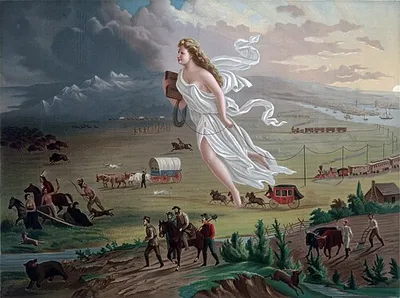
Manifest Destiny itself was a 19th-century American belief that settlers were destined to expand westward across North America. It was fueled by American exceptionalism and romantic nationalism, suggesting an inevitable spread of republicanism and the American way of life. The concept was deeply divisive, leading to conflicts over slavery and the displacement of Indigenous Americans. While proponents saw it as a divinely ordained mission, critics viewed it as a justification for chauvinism and self-interest, particularly in the context of territorial expansion and acquisition of lands.
The Ambiguity of Manifest Destiny
Ernest Lee Tuveson's analysis points to the inherent ambiguity and lack of a singular, coherent definition for the concept of 'Manifest Destiny.' He described it as a broad collection of ideas, policies, and actions that were not necessarily compatible and emerged from diverse origins. This lack of a fixed ideological framework allowed for divergent interpretations and applications of the term throughout its history. Tuveson's observation underscores the challenge in understanding Manifest Destiny as a monolithic doctrine, emphasizing instead its fluid and often contradictory nature as it was invoked to justify various expansionist endeavors.
Manifest Destiny: A Complex Ideological Landscape
The belief in Manifest Destiny, prevalent in 19th-century America, was rooted in a conviction of the nation's unique moral virtue and a mission to spread republican government and the 'American way of life.' This was often intertwined with notions of American exceptionalism and romantic nationalism. Historians note that the concept was not a rigid policy but a general sentiment that fueled westward expansion and territorial acquisition. However, it remained a contentious issue, sparking debates over slavery, conflicts with Indigenous peoples, and wars with neighboring nations. The phrase itself was coined in the mid-1840s, becoming a significant political slogan that justified actions like the annexation of Texas and the Oregon boundary dispute.
Key Ideas
- Manifest Destiny is a vast complex of ideas, policies, and actions.
- These elements are not always compatible.
- They do not originate from any one source.
Notable Quotes
“A vast complex of ideas, policies, and actions is comprehended under the phrase 'Manifest Destiny'. They are not, as we should expect, all compatible, nor do they come from any one source.”
Books by Ernest Lee Tuveson
3 free public domain books · Read online or download