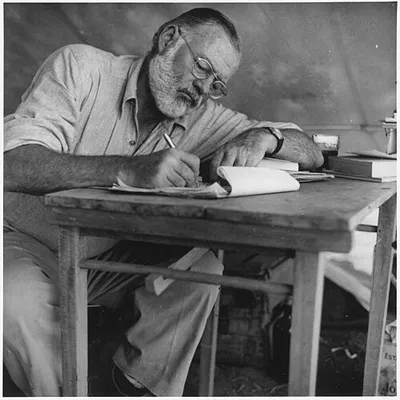
Ernest Hemingway
Ernest Hemingway, an American author, significantly influenced 20th-century fiction with his distinct writing style and was a Nobel Prize laureate.
Ernest Hemingway was an American writer, known for his novels and short stories, who lived from 1899 to 1961. His distinctive, concise writing approach, which he referred to as the "iceberg theory," profoundly impacted the landscape of fiction in the 20th century. Many of his books are now considered cornerstones of American literature. Hemingway's most prolific writing period spanned from the mid-1920s to the mid-1950s. His literary achievements were recognized with the Nobel Prize in Literature in 1954. Over his career, he authored seven novels, six collections of short stories, and two nonfiction books. Additionally, a significant portion of his work, including three novels, four short-story collections, and three nonfiction titles, was published after his death.
Literary Style and Influence
Hemingway's writing is characterized by its economy and understatement, a method he famously termed the "iceberg theory." This approach involved presenting only the essential elements of a story, allowing deeper meanings and emotions to be inferred by the reader. This minimalist style exerted a considerable influence on subsequent generations of fiction writers, shaping the direction of 20th-century literature. His ability to convey profound themes through spare prose cemented his reputation as a master craftsman.
Major Works and Recognition
During his most active writing years, from the mid-1920s to the mid-1950s, Hemingway produced a substantial body of work. His literary contributions were honored with the prestigious Nobel Prize in Literature in 1954. His published output included seven novels, six collections of short stories, and two nonfiction works. A notable aspect of his literary legacy is that a significant portion of his work, comprising three novels, four short-story collections, and three nonfiction titles, was released posthumously, further extending his impact.
Key Ideas
- Iceberg theory: A writing technique emphasizing economy and understatement, where only the surface is shown, implying deeper meaning.
Books by Ernest Hemingway
2 free public domain books · Read online or download