Elder Therion
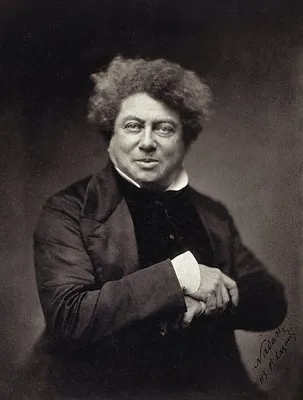
Alexandre Dumas was a prolific French author of adventure novels and plays, whose diverse life included political involvement and extensive travel.
Alexandre Dumas, born Alexandre Dumas Davy de la Pailleterie in 1802, was a celebrated French novelist and playwright whose adventure stories, such as "The Three Musketeers" and "The Count of Monte Cristo," achieved widespread translation and adaptation. His career began successfully with plays, leading to a prolific output that reportedly totaled 100,000 pages across various genres, including travel books and historical novels originally published in serial form. Dumas's father, Thomas-Alexandre Dumas, was a distinguished general of Afro-Caribbean descent, born in the French colony of Saint-Domingue (modern Haiti) to a French nobleman and an enslaved African woman. This heritage contributed to a complex family history that shaped Dumas's own life and potential influences, though direct connections to esoteric themes are not detailed in the provided text. Dumas was also involved in political events, including the 1830 Revolution, and later founded a newspaper supporting Italian unification. His personal life was marked by generosity and a lavish lifestyle, leading to periods of financial difficulty and expatriation to Belgium and Russia before his return to Paris. He died in 1870.
Ancestry and Early Life
Alexandre Dumas was born in France in 1802, the son of Thomas-Alexandre Dumas and Marie-Louise Élisabeth Labouret. His paternal grandfather, Alexandre Antoine Davy de la Pailleterie, was a French nobleman who fathered Thomas-Alexandre with Marie-Cessette Dumas, an enslaved woman of African ancestry in the French colony of Saint-Domingue (present-day Haiti). Thomas-Alexandre, after being brought to France by his father, gained his freedom and pursued a successful military career, becoming the first soldier of Afro-Antilles origin to reach the rank of general in the French army. He adopted the surname Dumas, possibly devised by himself or his mother. Alexandre Dumas inherited this surname and grew up with a lineage that included both French aristocracy and African heritage, a background that, while not explicitly linked to esoteric traditions in the source, formed a unique aspect of his identity.
Literary Career and Public Life
Dumas launched his writing career in Paris with successful plays, earning acclaim for works like "Henry III and His Court" and "Christine." This initial success provided the financial means to pursue writing full-time. He transitioned to novels, becoming renowned for his adventure stories, many of which were initially published as serials in newspapers. His prodigious output, estimated at 100,000 pages, spanned numerous genres. Dumas was also a figure of public life, participating in the 1830 Revolution and later founding the newspaper "L'Indépendant" to support Italian unification. His life was characterized by a generous spirit and an extravagant lifestyle, which often led to financial challenges, prompting him to live abroad in Belgium and Russia for periods before returning to France.
Collaborations and Legacy
Dumas's prolific writing often involved collaborations. He established a studio where assistants helped produce a vast amount of material under his direction and editing. His fencing master, Augustin Grisier, collaborated on "The Fencing Master," and Auguste Maquet was a significant collaborator whose contributions were later recognized in legal proceedings. Dumas's novels, translated into many languages, became immensely popular, leading to hundreds of film adaptations since the early 20th century. Despite earning considerable wealth, his lavish spending and generosity frequently left him in debt. His estate, the Château de Monte-Cristo, built outside Paris, reflected his grand lifestyle but was eventually sold due to financial pressures. His extensive body of work cemented his status as one of the most widely read French authors.
Notable Quotes
“the most generous, large-hearted being in the world. He also was the most delightfully amusing and egotistical creature on the face of the earth. His tongue was like a windmill – once set in motion, you would never know when he would stop, especially if the theme was himself.”
Books by Elder Therion
2 free public domain books · Read online or download