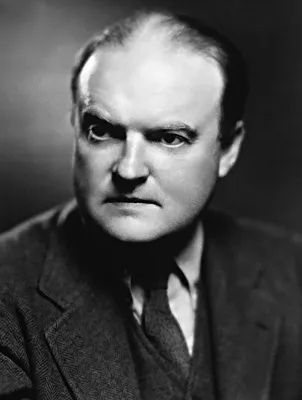
Edmund Wilson
Edmund Wilson was a prominent 20th-century American critic and journalist, known for his broad intellectual scope and critical engagement with literature and society.
Edmund Wilson Jr. was a highly influential American writer, literary critic, and journalist whose career spanned much of the 20th century. Widely recognized as one of the era's most important literary critics, Wilson began his professional life in journalism, contributing to and editing for prominent publications like Vanity Fair, The New Republic, The New Yorker, and The New York Review of Books. His critical work explored a vast range of subjects, from modern literature and early Christianity to native American civilization and the American Civil War, often venturing into fields typically reserved for academics.
Beyond his extensive critical essays and books, Wilson also penned fiction, including the novel I Thought of Daisy and the short story collection Memoirs of Hecate County. He was a friend and influential figure to many notable writers of his time. His lifelong advocacy for a comprehensive collection of American classics eventually led to the establishment of The Library of America series after his death. Wilson received numerous accolades, including two National Book Awards and the Presidential Medal of Freedom, and passed away in 1972 at the age of 77.
Literary Criticism and Intellectual Range
Edmund Wilson's legacy is primarily defined by his profound impact on literary criticism. His seminal work, "Axel's Castle," offered a groundbreaking analysis of modern literature, particularly Symbolism, examining authors like Rimbaud, Yeats, Eliot, Proust, and Joyce. Wilson fearlessly tackled diverse intellectual territories, delving into the study of early Christianity in "The Dead Sea Scrolls," exploring native American civilization in "Apologies to the Iroquois," and dissecting the American Civil War in "Patriotic Gore." His critical essays often engaged with contemporary social and political issues, reflecting a deep commitment to understanding the cultural landscape. Despite his broad influence, Wilson was known for his sharp critiques, famously dismissing H.P. Lovecraft's tales as "hackwork" and J.R.R. Tolkien's "The Lord of the Rings" as "juvenile trash."
Social and Political Commentary
Beyond literary analysis, Edmund Wilson was a vocal commentator on social and political matters. During the Cold War, he openly criticized US policies, notably refusing to pay federal income taxes for nearly a decade as a form of protest. In his book "The Cold War and the Income Tax: A Protest," he argued that the anti-communist fervor paradoxically undermined American civil liberties. This stance also extended to his opposition to the Vietnam War. Wilson's critical eye was not limited to government actions; he also engaged with ideological movements, tracing the history of European socialism in "To the Finland Station." His involvement extended to practical matters, such as serving on the Dewey Commission to evaluate charges against Leon Trotsky.
Personal Life and Relationships
Edmund Wilson's personal life was marked by multiple marriages and significant friendships with leading literary figures of his era, including F. Scott Fitzgerald, Ernest Hemingway, John Dos Passos, and Vladimir Nabokov. His relationship with Fitzgerald was particularly close, with Fitzgerald referring to Wilson as his "intellectual conscience." Wilson played a role in editing Fitzgerald's posthumous works. He also had a complex relationship with Nabokov, marked by extensive correspondence but strained by Wilson's reactions to "Lolita" and Nabokov's translation of Pushkin. Wilson's marriages, including those to Mary Blair, Margaret Canby, Mary McCarthy, and Elena Mumm Thornton, were significant aspects of his life, though sometimes tumultuous, as evidenced by his marriage to McCarthy.
Key Ideas
- Literary criticism as a broad intellectual pursuit
- Critique of Cold War policies and their impact on civil liberties
- Advocacy for the preservation and dissemination of classic American literature
Notable Quotes
“Tales of the Marvellous and the Ridiculous”
“hackwork”
“juvenile trash”
“Dr. Tolkien has little skill at narrative and no instinct for literary form.”
“intellectual conscience”
Books by Edmund Wilson
4 free public domain books · Read online or download