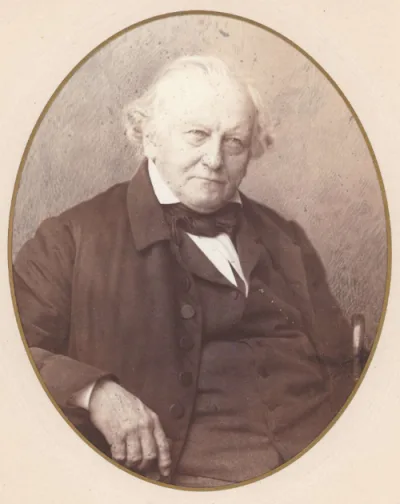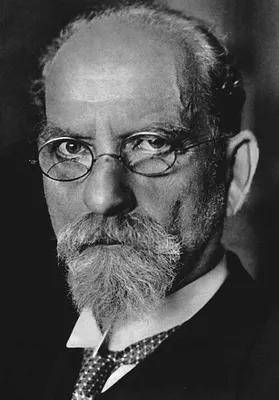
Edmund Husserl
Edmund Husserl was a philosopher who founded phenomenology, a school of thought focused on consciousness and experience.
Edmund Husserl, born in 1859 in the Austrian Empire, was a philosopher and mathematician who established the school of phenomenology. Initially a mathematician who studied under prominent figures like Karl Weierstrass and Leo Königsberger, he later shifted his focus to philosophy, influenced by Franz Brentano and Carl Stumpf. Husserl's academic career led him to professorships at various German universities, including Halle, Göttingen, and Freiburg. His philosophical work aimed to develop a foundational science based on phenomenological reduction, exploring the nature of consciousness and its role in knowledge. Despite facing significant personal loss, including the death of his son in World War I, and later persecution under Nazi racial laws, Husserl remained a prolific thinker until his death in 1938. His ideas profoundly impacted 20th-century philosophy and continue to be influential.
Foundations of Phenomenology
Edmund Husserl is recognized as the founder of phenomenology, a philosophical approach that emphasizes the study of consciousness and the structures of experience. His early critiques targeted historicism and psychologism in logic, focusing on the concept of intentionality – the idea that consciousness is always directed toward an object. In his mature work, Husserl sought to establish a rigorous foundational science through a method known as phenomenological reduction. This method involves bracketing out assumptions about the external world to focus on the essential structures of conscious experience itself. He posited that transcendental consciousness defines the boundaries of all possible knowledge, leading him to define phenomenology as a transcendental-idealist philosophy.
Academic Career and Influences
Husserl's intellectual journey began with studies in mathematics, physics, and astronomy at universities in Leipzig, Berlin, and Vienna. He was tutored by leading mathematicians like Karl Weierstrass and Leo Königsberger, and later influenced by philosophers Franz Brentano and Carl Stumpf. After earning his PhD in mathematics, Husserl dedicated himself to philosophy, inspired by Brentano's lectures. He began his teaching career as a Privatdozent at the University of Halle in 1887, eventually becoming a full professor at Göttingen and later Freiburg. His academic positions allowed him to develop and disseminate his phenomenological ideas through lectures and publications, attracting notable students and collaborators.
Later Life and Persecution
Despite retiring from his professorship at Freiburg in 1928, Husserl continued to be highly productive, delivering influential lectures and publishing significant works. His later thought explored concepts like the phenomenological epoché and the transcendental ego. However, his life and work were tragically impacted by the rise of Nazism. In 1933, due to his Jewish heritage, Husserl was banned from using the University of Freiburg's library and resigned from the Deutsche Akademie. He continued his philosophical work in isolation until his death in Freiburg in 1938, leaving behind a profound legacy that shaped subsequent philosophical discourse.
Key Ideas
- Phenomenology: A philosophical method and school focused on the study of consciousness and experience.
- Intentionality: The directedness of consciousness toward objects.
- Phenomenological Reduction (Epoché): A method of bracketing assumptions to focus on the essential structures of experience.
- Transcendental Consciousness: The idea that consciousness sets the limits of all possible knowledge.
- Transcendental Idealism: Husserl's classification of phenomenology as a philosophy that emphasizes the role of the mind in constituting reality.
Books by Edmund Husserl
4 free public domain books · Read online or download