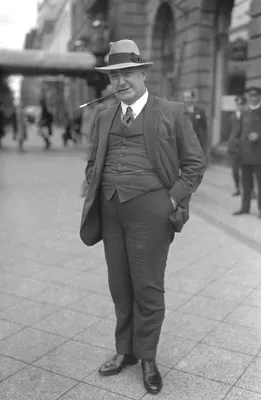
Edgar Wallace
Edgar Wallace was a prolific British author of crime and adventure fiction, known for his vast output and international success.
Richard Horatio Edgar Wallace, born in London in 1875 to theatrical parents, experienced a childhood marked by poverty and adoption. He left formal education at 12 and held various jobs before enlisting in the army under the name Edgar Wallace. His early career included serving as a war correspondent during the Second Boer War for major publications.
Wallace began writing to alleviate debt, producing thrillers like The Four Just Men. His experiences reporting on atrocities in the Congo inspired the Sanders of the River series. He became an exceptionally prolific writer, producing novels, short stories, screenplays, and plays. Despite facing financial difficulties and personal tragedies, including the early death of a child, he achieved international recognition. He later moved to Hollywood to work as a scriptwriter and died suddenly in 1932 during the initial drafting of King Kong.
Early Life and Career Beginnings
Born Richard Horatio Edgar Marriott Edgar in Greenwich, London, in 1875, Wallace was the son of actors. His mother, Mary Jane Richards, worked in the theatre, and his family had connections to the entertainment world. Wallace's parents had a brief encounter, resulting in his birth. His mother, unable to support him, arranged for his adoption by the Freeman family. Known as Richard Horatio Edgar Freeman, he had a stable upbringing but left school at age 12 after attending boarding school. He worked numerous jobs before enlisting in the British Army at 21, using the name Edgar Wallace. He served in South Africa and eventually transferred to the Press Corps, finding it a better fit for his interests.
Prolific Writing Career and International Success
Wallace transitioned to full-time writing after leaving the army in 1899, initially focusing on songs and poetry, inspired by Rudyard Kipling. He worked as a war correspondent during the Boer War. To address mounting debts, he began writing detective fiction and thrillers. His independent publishing venture, The Four Just Men (1905), faced financial challenges, requiring support from newspaper magnate Alfred Harmsworth. Stories drawn from his reporting on the Congo, detailing atrocities under Belgian rule, were collected in Sanders of the River (1911). This marked the beginning of an extremely productive period where he wrote over 170 novels, 957 short stories, and numerous other works, including screenplays and plays. He signed with Hodder & Stoughton in 1921, which facilitated his rise to international fame.
Later Life and Legacy
Wallace's prolific output continued throughout his life, with a significant portion of his work being adapted into films, with over 160 movies based on his stories. In the 1931 general election, he unsuccessfully ran as a Liberal MP. He subsequently relocated to Hollywood to work as a scriptwriter for RKO. His sudden death in 1932 from undiagnosed diabetes occurred while he was involved in the early stages of developing the script for King Kong. His legacy includes being recognized for his contributions to crime and adventure fiction, particularly his "colonial imagination" works and the J. G. Reeder detective series. Despite many of his books being out of print in the UK, they remain popular in Germany, where numerous titles are still available.
Key Ideas
- Writing as a means to overcome debt and financial hardship.
- Drawing inspiration from journalistic experiences, including war and colonial atrocities.
- The concept of the "colonial imagination" in literature.
- The immense productivity of a single author in the thriller genre.
Books by Edgar Wallace
2 free public domain books · Read online or download