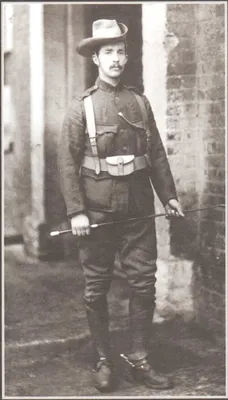
Douglas Erskine
Erskine Childers was an English-born Irish nationalist, author, and gun-runner whose life culminated in execution for his anti-Treaty stance.
Robert Erskine Childers, born in England in 1870, became a prominent Irish nationalist and author. Initially a supporter of the British Empire, his experiences in the Second Boer War led to a profound disillusionment with imperialism. He transitioned from advocating for Irish Home Rule to championing outright Irish republicanism.
Childers is best known for his novel "The Riddle of the Sands," which depicted a potential German invasion of England and influenced naval policy. He played a crucial role in smuggling arms for the Irish Volunteers, which were later used in the Easter Rebellion. His involvement in the Anglo-Irish Treaty negotiations was significant, though he ultimately opposed the treaty and was elected as an anti-Treaty member of the first Irish parliament. His active participation in the subsequent Irish Civil War led to his execution by the Irish Free State in 1922.
Early Life and Education
Born in London in 1870, Robert Erskine Childers was the son of a British Orientalist scholar and an Irish woman from a landowning family. Orphaned at a young age, he was raised by his maternal relatives in County Wicklow, Ireland, developing a deep connection to the country. His education began at home before he attended Haileybury College and later Trinity College, Cambridge, where he studied classics and law. Despite initial physical limitations from a sciatic injury, he excelled academically and in extracurricular activities, including editing the university magazine and leading the Trinity College Debating Society. He briefly pursued a legal career before entering parliamentary service as a junior committee clerk in the House of Commons.
Literary and Naval Influence
Childers' most celebrated work is the 1903 novel "The Riddle of the Sands." This gripping tale of espionage and a potential German invasion of Britain gained significant attention and is credited with influencing Winston Churchill, then First Lord of the Admiralty, to bolster the Royal Navy's Home Fleet. The novel's prescient themes of geopolitical tension and naval strategy resonated deeply and contributed to Childers' reputation as a writer. His literary output, stemming from his personal experiences and observations, often touched upon themes of national identity and political conflict.
Irish Nationalism and Activism
Childers' life took a decisive turn towards Irish nationalism following his service in the Boer War, which fostered a deep skepticism of British imperialism. He became actively involved with the Irish Volunteers, famously using his yacht, the "Asgard," to smuggle 900 rifles and ammunition into Howth in 1914, arms that would later be used against British forces. He was a key figure in the negotiations leading to the Anglo-Irish Treaty. However, he ultimately rejected the treaty's terms, becoming an anti-Treaty representative in the first Irish parliament. This stance led him to participate in the Irish Civil War, a conflict that tragically ended with his execution by the Irish Free State in November 1922.
Books by Douglas Erskine
2 free public domain books · Read online or download