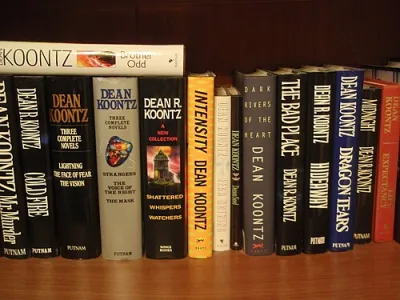
Dean Koontz is a prolific American author whose suspense thrillers often blend genres and have achieved significant commercial success.
Dean Ray Koontz, born in 1945, is an American author widely known for his suspense thriller novels that frequently incorporate elements of horror, fantasy, science fiction, mystery, and satire. His prolific career has resulted in over 105 novels, numerous novellas, and short story collections, with sales exceeding 500 million copies worldwide. Many of his works have topped The New York Times Best Seller list, with numerous titles reaching the number-one position in both hardcover and paperback formats. Early in his career, Koontz utilized various pen names, including "David Axton" and "Leigh Nichols," before establishing his own name as a prominent figure in popular fiction. His writing has been recognized for its suspense-building and characterization, earning him acclaim as a successful and celebrated writer.
Koontz's personal experiences, including a difficult childhood marked by abuse and his later conversion to Catholicism, have influenced his worldview and writing. He has spoken about his distrust of government programs, stemming from his time working with the Appalachian Poverty Program, which shaped his political outlook towards a blend of liberalism on civil rights and conservatism on defense. His Catholic faith, which he embraced for its existential answers and sense of wonder, is reflected in his work through themes of spirituality, grace, and the human struggle, though he emphasizes he does not preach.
Beyond his literary achievements, Koontz is known for his philanthropy, particularly his support for organizations providing service dogs, inspired in part by his own beloved Golden Retriever, Trixie. His writing career began with science fiction before transitioning to suspense and horror, leading to significant commercial success. Despite his prolific output, Koontz has also addressed issues of disputed authorship, clarifying that certain works attributed to him were not his own creations.
Literary Style and Themes
Dean Koontz's novels are primarily categorized as suspense thrillers, but they are notable for their eclectic blend of genres. He frequently weaves in elements of horror, fantasy, science fiction, mystery, and even satire, creating a unique reading experience. His works have achieved widespread commercial success, with a significant number appearing on The New York Times Best Seller list, and many reaching the coveted number-one spot. Koontz has also explored spiritual themes in his writing, influenced by his conversion to Catholicism. He views faith as a source of existential answers and a means to perceive mystery and wonder in life, drawing parallels to the perspective of G. K. Chesterton. While spirituality, grace, and the struggle of the human condition are present in his narratives, Koontz asserts that he avoids didacticism, focusing instead on storytelling.
Early Life and Influences
Born in Pennsylvania in 1945, Dean Koontz's early life was marked by hardship, including abuse from his alcoholic father. These experiences, alongside witnessing his mother's resilience, profoundly shaped his perspective and later writing. His time working for the Appalachian Poverty Program in the 1960s significantly influenced his political views, leading him to develop a deep distrust of government initiatives and a complex ideological stance. After graduating college, where he won a fiction competition, Koontz initially worked as an English teacher before dedicating himself to writing. His conversion to Catholicism in college provided him with a framework for understanding life's complexities and instilled a sense of joy and wonder that he has carried into his literary career.
Career Development and Pseudonyms
Koontz began his writing career in earnest while working as a teacher, publishing his first novel in 1968. He initially wrote numerous science fiction novels before shifting towards suspense and horror. To navigate genre shifts and avoid alienating readers, he adopted several pen names, including "David Axton," "Deanna Dwyer," "K. R. Dwyer," "Leigh Nichols," and "Brian Coffey." He sometimes published multiple books annually under these different identities. While many of his pseudonymous works are now available under his real name, Koontz has also bought back the rights to some, choosing not to republish them. His breakthrough novel, "Whispers" (1980), marked a significant turning point, solidifying his status as a bestselling author and paving the way for continued success.
Philanthropy and Personal Life
Dean Koontz is recognized not only for his literary output but also for his significant philanthropic efforts, particularly his support for Canine Companions for Independence (CCI), an organization providing service dogs. His involvement was inspired by his Golden Retriever, Trixie, who was a CCI service dog. Koontz's substantial donations to CCI, totaling millions, have helped fund the training and placement of numerous service dogs. He has even written books from a canine perspective, with royalties benefiting the charity. His personal life includes his wife, Gerda, and a deep affection for his dogs, who have often played a role in his public image and even inspired specific works. He has lived in Orange County, California, for many years.
Key Ideas
- Suspense thrillers blending multiple genres
- Exploration of spirituality, grace, and the human struggle
- Influence of personal hardship and faith on writing
- Skepticism towards government programs
- The role of dogs in life and inspiration
Notable Quotes
““America’s most popular suspense novelist””
““very noble and wonderful, ... [i]n reality, it was a dumping ground for violent children ... and most of the funding ended up 'disappearing somewhere.'”
“I realized that most of these programs are not meant to help anyone, merely to control people and make them dependent. I was forced to reconsider everything I'd once believed. I developed a profound distrust of government regardless of the philosophy of the people in power. I remained a liberal on civil-rights issues, became a conservative on defense, and a semi-libertarian on all other matters.”
“intellectual rigor”
“joy about the gift of life”
Books by
6 free public domain books · Read online or download