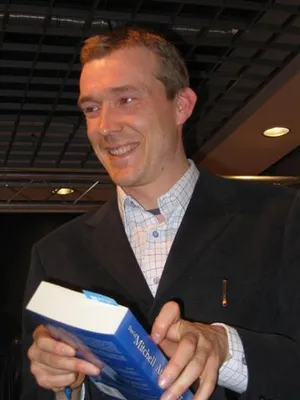
David Smith
David Mitchell is an English author whose novels explore interconnected worlds, often featuring fantastical elements and philosophical themes.
David Mitchell, born in 1969, is an English novelist, screenwriter, and translator recognized for his intricate narratives and expansive fictional universe, which he terms his 'macronovel.' His literary career began with 'Ghostwritten' (1999), followed by acclaimed works like 'number9dream' (2001) and 'Cloud Atlas' (2004), both shortlisted for the Booker Prize. Mitchell's writing frequently incorporates elements of the fantastic and philosophical inquiry, examining themes that bridge life and death, and the human condition.
Beyond his novels, Mitchell has ventured into screenwriting, contributing to projects like 'Sense8' and co-writing the screenplay for 'The Matrix Resurrections.' He has also engaged in translation, notably working with his wife on books by Naoki Higashida concerning autism. His personal experiences, including raising an autistic son and his own stammer, have informed his writing and advocacy. Mitchell was elected a Fellow of the Royal Society of Literature in 2013.
Literary Style and Themes
David Mitchell's body of work is characterized by its ambitious scope and interconnectedness, forming what he calls a 'macronovel.' His narratives often weave together multiple storylines and perspectives, exploring a wide range of locations and time periods. Themes of existence, consciousness, and the nature of reality are recurrent. Books like 'Cloud Atlas' and 'The Bone Clocks' delve into speculative and fantastical elements, prompting reflection on the boundaries between life and death. This intricate construction and exploration of complex philosophical ideas have established him as a significant voice in contemporary literature.
Cross-Media Contributions and Translation
Mitchell's creative output extends beyond novels into screenwriting and opera libretti. His novel 'Cloud Atlas' was adapted into a feature film, leading him to collaborate on screenplays for television series such as 'Sense8' and the film 'The Matrix Resurrections.' He has also penned libretti for operas like 'Wake' and 'Sunken Garden.' A notable aspect of his work involves translation, particularly of books by Naoki Higashida concerning autism, including 'The Reason I Jump' and 'Fall Down 7 Times Get Up 8.' This endeavor was deeply personal, stemming from his experiences as the parent of an autistic child.
Personal Influences and Advocacy
Mitchell's personal life has significantly influenced his writing and public engagement. He openly discusses his stammer, finding parallels in the film 'The King's Speech' and exploring the theme in his novel 'Black Swan Green.' His experiences as a parent to a severely autistic son have led him to translate books on the subject and become an advocate, viewing the challenges as a source of profound learning about compassion and the human heart. He and his wife, Keiko Yoshida, have also translated further works by autistic authors, aiming to share their insights.
Key Ideas
- The concept of a 'macronovel' where all his fictional works are interconnected.
- Exploration of philosophical themes, including consciousness, reality, and the human condition.
- Interweaving of fantastical elements with everyday life.
- The profound impact of personal experiences, such as autism and stammering, on identity and worldview.
Notable Quotes
“I knew I wanted to be a writer since I was a kid, but until I came to Japan to live in 1994 I was too easily distracted to do much about it.”
“I'd probably still be avoiding the subject today had I not outed myself by writing a semi-autobiographical novel, Black Swan Green, narrated by a stammering 13-year-old.”
“you have to become a stronger, kinder, more compassionate, more patient, tougher, clear-sighted person”
“real enlightenment about the human condition and the human heart”
“a revelatory godsend”
Books by David Smith
2 free public domain books · Read online or download