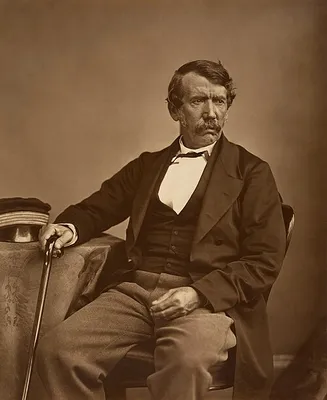
David Livingstone was a Scottish missionary, doctor, and explorer who became a celebrated Victorian hero for his African expeditions and anti-slavery advocacy.
David Livingstone, born in Scotland in 1813, was a physician, missionary, and renowned explorer of Africa. He married into the prominent Moffat missionary family and achieved legendary status in Victorian Britain. Livingstone was seen as a Protestant martyr, a rags-to-riches success, a scientific observer, an imperial reformer, and a fervent opponent of the slave trade. His explorations, particularly his quest to find the sources of the Nile, were driven by a desire to gain influence to combat the East African slave trade. His expeditions were part of a broader era of European geographical discovery and colonial expansion into Africa.
Livingstone's missionary journeys, his subsequent 'disappearance,' and his eventual death in Africa, followed by his posthumous glorification as a national hero, significantly influenced the establishment of Christian missionary initiatives during the European 'Scramble for Africa.' His early life in a Scottish cotton mill instilled in him persistence and empathy, while his intellectual development was shaped by a blend of theological study and a deep interest in science, seeking to reconcile faith and nature. He pursued medical and theological education, driven by a vision to serve as a missionary, eventually embarking on his journey to Africa in 1840.
Early Life and Influences
Born in Blantyre, Scotland, in 1813, David Livingstone began his working life at the age of ten in a cotton mill, enduring long hours. This experience fostered his resilience and a deep empathy for laborers, later reflected in his appreciation for Robert Burns' egalitarian poetry. His father, Neil Livingstone, a devout Sunday school teacher and teetotaller, instilled in him a love for reading, particularly theology and accounts of missionary endeavors. Despite his father's concerns that scientific reading might undermine faith, young David developed a keen interest in science and nature, seeking to integrate it with his religious beliefs. Philosophical works, notably Thomas Dick's 'Philosophy of a Future State,' provided him with a framework to reconcile his faith and scientific curiosity. Influenced by evangelists and Congregationalist preachers, Livingstone embraced a theology that emphasized universal salvation and the accessibility of the Holy Spirit, which liberated him from fears of eternal damnation.
Path to Missionary Work and Education
Livingstone's path toward missionary work was significantly shaped by a call for medical missionaries to China, which he saw as a means to advance religious goals. He pursued medical studies at Anderson's University in Glasgow, balancing his education with continued work in the mill to support his family. He also attended theological lectures, where he encountered figures like Richard Wardlaw, an anti-slavery advocate. His academic pursuits involved mastering Latin and engaging in theological studies. He applied to the London Missionary Society (LMS) and, after a period of assessment, was accepted as a candidate for ministerial training. He received further instruction in classical languages and theology before commencing clinical medical training in London, studying at Charing Cross Hospital. He qualified as a physician in 1840 and was ordained as a minister shortly thereafter, preparing him for his future mission.
Vision for Africa and Early Expeditions
Initially responding to a call for missionaries to China, Livingstone's plans shifted due to geopolitical concerns. The London Missionary Society considered assigning him to the West Indies, but Livingstone expressed a preference for other regions and not a settled pastoral role. His encounter with missionary Robert Moffat, who was publicizing his work in South Africa, proved pivotal. Moffat encouraged Livingstone to consider advancing into unoccupied territories north of Bechuanaland, a vast area previously unreached by missionaries. This vision resonated with Livingstone, particularly in conjunction with the emerging ideas about the link between Christianity and commerce. Influenced by abolitionist arguments, he became convinced that promoting 'legitimate trade' could undermine the slave trade and that Christian missions could introduce civilization and education. In November 1840, Livingstone departed for the Cape of Good Hope, commencing his long journey to Africa and beginning his studies of Dutch and the Tswana language en route.
Key Ideas
- Reconciling science and religion
- Missionary work as a means to combat the slave trade
- The link between Christianity, civilization, and legitimate commerce
Notable Quotes
“The Nile sources are valuable only as a means of opening my mouth with power among men. It is this power [with] which I hope to remedy an immense evil.”
“When man to man, the world o'er/Shall brothers be for a' that”
Books by
2 free public domain books · Read online or download