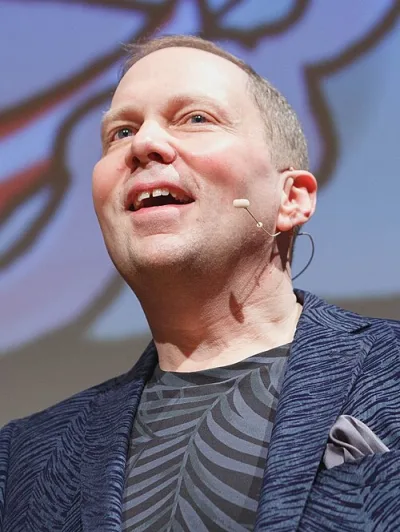
Dav Pilkey is a children's author and illustrator known for Captain Underpants and Dog Man.
Dav Pilkey, born March 4, 1966, is an American author and illustrator celebrated for his children's fiction. He is most recognized for creating the wildly popular Captain Underpants series and its equally successful spin-off, Dog Man. These series are presented as creations of the characters George Beard and Harold Hutchins, who are also central figures in the Captain Underpants universe. Pilkey's early life included a conservative Christian upbringing and challenges with ADHD and dyslexia, experiences that influenced his creative output, including the initial conception of Captain Underpants. He graduated from Kent State University and has been married since 2005. Pilkey has also authored other series like Dragon and The Dumb Bunnies, and contributed to various anthologies. He has received numerous awards for his contributions to children's literature.
Early Life and Creative Beginnings
Born in Cleveland, Ohio, Dav Pilkey was raised in a conservative Christian environment and attended religious schools. Diagnosed with ADHD and dyslexia as a child, he often found himself in trouble for his behavior in class. During his elementary school years in North Ridgeville, Ohio, he would spend time in the school hallway, where he first developed the character of Captain Underpants. Pilkey's first published work, 'World War Won,' an allegorical story inspired by the nuclear arms race, was written in 1987 and received an award in a national student author competition. His first name's unconventional spelling originated from a misplaced name tag at a Pizza Hut job.
Career Highlights and Major Works
Pilkey's career gained significant momentum with the publication of 'Captain Underpants' in 1997. This was followed by 'The Adventures of Super Diaper Baby' in 2002, which was his first complete graphic novel and achieved bestseller status on USA Today and The New York Times lists. He later took a hiatus from writing to care for his terminally ill father, returning in 2009 with a commitment to Scholastic for new books. This period saw the release of further 'Captain Underpants' titles and the graphic novels 'The Adventures of Ook and Gluk: Kung-Fu Cavemen from the Future' and 'Super Diaper Baby 2: Invasion of the Potty Snatchers.' The highly successful 'Dog Man' series, also presented as creations of George and Harold, began in 2016, followed by the 'Cat Kid Comic Club' series.
Pseudonyms and Creative Collaboration
Pilkey often utilizes pseudonyms, most notably George Beard and Harold Hutchins, the fictional protagonists of the Captain Underpants series. These characters are depicted within the narrative as the authors and illustrators of the comic books they create, including the Super Diaper Baby and Dog Man series. This narrative device allows Pilkey to present these works as if they were created by his own characters. He also wrote the 'Dumb Bunnies' series under the pseudonym Sue Denim. His early illustrations for the Dragon series utilized watercolors purchased from a local grocery store.
Recent Developments and Social Stance
In March 2021, Dav Pilkey announced his decision, in collaboration with Scholastic, to cease publication and remove 'The Adventures of Ook and Gluk: Kung-Fu Cavemen from the Future' from circulation. This action was taken because certain characters in the book were identified as perpetuating stereotypes. Pilkey emphasized his commitment to promoting diversity, equality, and non-violent conflict resolution, stating that even unintentional stereotypes can be harmful. He pledged to donate all his earnings from the book to organizations dedicated to supporting diversity and combating anti-Asian violence.
Key Ideas
- Using fictional characters as pseudonyms for published works
- Addressing childhood learning differences (ADHD, dyslexia) through creative expression
- Promoting diversity, equality, and non-violence in children's literature
- The impact of stereotypes in media
Books by
3 free public domain books · Read online or download